New book on global space age features chapter by History faculty Subodhana Wijeyeratne

Department of History Assistant Professor Subodhana Wijeyeratne is author of a chapter in the newly released book, Cosmic Fragments: Dislocation and Discontent in the Global Space Age. Published by University of Pittsburgh Press, the volume explores histories of space travel across nations and regions to better understand the destructive power of infrastructure, waste, and exploitative legal regimes at the height of the space age.
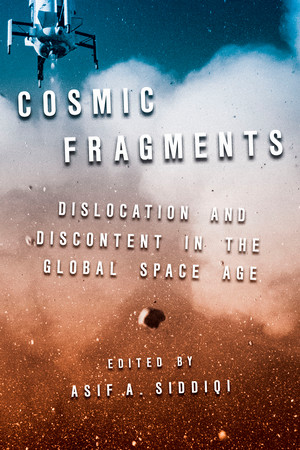 In his chapter, ‘Earthly Dreams and Cosmic Afterlives: The Failure and Reutilization of Japanese Space Facilities,’ Dr. Wijeyeratne delves into the complex legacy of Japan’s space infrastructure. Focusing on sites like Akita, Uchinoura, and Tanegashima, he examines how these facilities, initially heralded as catalysts for economic revival, often fell short, leading local communities to reimagine their roles as cultural landmarks and centers for grassroots innovation. This chapter contributes to the volume’s overarching aim of challenging traditional narratives of space exploration by highlighting themes of environmental degradation, local dispossession, and infrastructural entanglements. Wijeyeratne’s broader research explores the technopolitical legacies in postwar Japan; his next project will be on the history of oceanography in Japan.
The full description from the publisher’s webpage highlights the significance of the volume in the field of the history of space exploration:
Looking beyond the well-trodden, celebratory narratives of space exploration and the powerful nostalgia of lunar landings, Cosmic Fragments focuses instead on the moral ambiguities of spaceflight. Beyond the fetishization of machines, men, and manifest destiny and the Cold War tensions of the space race lies a history rife with violence, racial inequity, colonial ambitions, and catastrophe. This volume yields new insights on the crucial role of environmental damage, Indigenous dispossession, population displacements, infrastructural entanglements, and narratives of decline in space exploration situated within larger questions in the history of science, technology, and the environment. Each chapter explores histories of space travel across nations and regions to better understand the destructive power of infrastructure, waste, and exploitative legal regimes at the height of the space age. Drawing from postcolonial science studies, science and technology studies, and anthropology, contributors suggest that phenomena designed to disenfranchise and dislocate, such as the displacement of Indigenous peoples, were deeply imbedded in the coloniality of space travel. By confronting and challenging problematic early accounts rooted in the cultural mores of settler colonialism, Cosmic Fragments offers a fundamental repositioning of the history of spaceflight.
Dr. Wijeyeratne is a historian of technology with a focus on East Asia in general, and Japan in particular. His primary historical interests are in the history of science and technology, specifically the interaction between humans and large-scale scientific endeavors such as space programs and deep-sea exploration.
Learn more about Assistant Professor Subodhana Wijeyeratne: https://cla.purdue.edu/directory/profiles/subodhana-wijeyeratne.html