Austin Cooper receives Fulbright Award for NATO Security Studies in Belgium
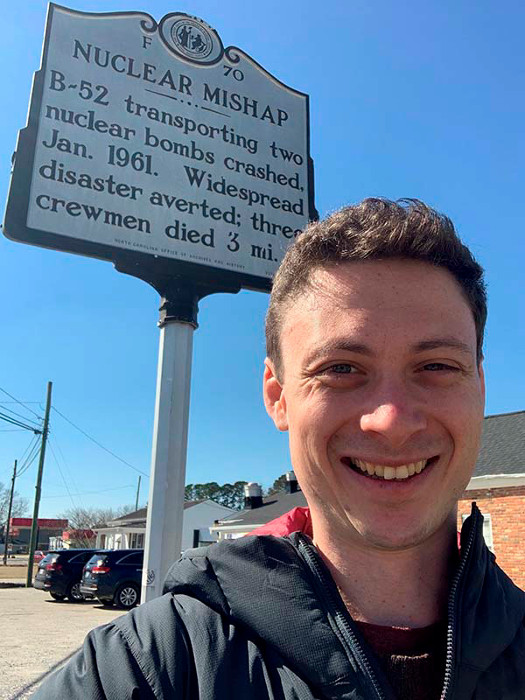
Austin Cooper, assistant professor in the Department of History, received the Fulbright Award for North Atlantic Treaty Organization (NATO) Security Studies. Dr. Cooper will conduct research in Belgium and the European Union during the Fall 2025 semester.
As part of the larger Fulbright U.S. Scholar Program, the Fulbright NATO Security Studies Award supports American academics and professionals as they conduct research focused on understanding NATO and transatlantic security. The Award aims to foster awareness, increase debate, and build connections related to peace, security, and defense.
Recipients receive funding to conduct research and/or lecture at a NATO member country for a period of three-to-four months in fields including but not limited to cybersecurity, military history, nuclear disarmament and non-proliferation, peace and security, security studies, and transatlantic studies.
During his tenure in Belgium, Dr. Cooper plans to begin a new book project, Inside North Atlantic Security, Outside the Alliance: French Nuclear Weapons during the 1970s.
“When new missile capabilities promised to make French nuclear deterrence of the Soviet Union credible in the early 1970s, the French government had already withdrawn these capabilities from NATO’s integrated command, meaning they did not coordinate with the rest of the alliance,” Dr. Cooper said.
Technical limitations in the range and evasiveness of the first French nuclear-capable strategic bomber fleet undermined the threat of French nuclear retaliation when these warplanes and their weapons became available during the 1960s.
“My project investigates how and why the Atlantic allies began to account for an independent French contribution to NATO’s defense and deterrence strategy, including the possibility of closer French cooperation with British nuclear forces and a smaller role for the United States in Europe,” explained Dr. Cooper. “This research speaks to ongoing debates over burden-sharing and risk-sharing in the transatlantic bargain: Which kinds of strategic and tactical systems, funded and operated by which nation(s), should hold which adversary targets at risk for credible deterrence and effective defense in the event the former should fail?”
Dr. Cooper added that the Award will facilitate his access to the NATO Archives in Brussels. He also plans to conduct archival research in London and Paris during his time in Europe. In Belgium, his institutional host is Prof. Tom Sauer, head of the Research Group International Politics at the University of Antwerp.
Dr. Cooper is a historian specializing in international politics since 1945 with a focus on nuclear technologies. He joined the Department of History at Purdue in 2023. Dr. Cooper is currently completing a book project, Saharan Fallout: French Nuclear Ambitions in Algeria during the Cold War Arms Race, exploring France’s emergence as a nuclear weapon state and its first nuclear testing program in the Algerian Sahara during the 1960s.
Additionally, he is a Senior Research Associate in the Center for International Studies at SciencesPo Paris, where he contributes to the Nuclear Knowledges program. Prior to joining Purdue, Dr. Cooper completed a postdoctoral fellowship supported by the Stanton Foundation in the Security Studies Program at the Massachusetts Institute of Technology and a fellowship in the Center for International Security and Cooperation at Stanford University. He earned his PhD in History and Sociology of Science from the University of Pennsylvania.
Learn more about Dr. Austin Cooper: https://cla.purdue.edu/directory/profiles/austin-cooper.html
Learn more about the Fulbright NATO Security Studies Award:
https://fulbrightscholars.org/award/nato-security-studies-7
Source: Austin Cooper, cooperar@purdue.edu