-
2025. Mancing, Howard, and Tatevik Gyulamiryan, editors. A Character Named Cervantes. University of Toronto Press. https://utppublishing.com/doi/book/10.3138/9781487558888
-
2025. Kelly, Daniel (with co-authors Michael Brownstein and Alex Madva). Somebody Should Do Something. How Anyone Can Help Create Social Change (monograph). MIT Press. https://mitpress.mit.edu/9780262049788/somebody-should-do-something/
-
2025. Leverage, Paula. “Creative Etymologies: A Cross Disciplinary Analysis of Creativity.” Leonardo (The MIT Press), vol. 58, no. 3, pp. 235-40. https://doi.org/10.1162/leon_a_02701
-
2025. William, Jen. “‘An Adventure of the Strangest Kind’: Dialogue Across the Centuries in Paul Scheerbart’s Fantasy Novella Cervantes.” A Character Named Cervantes, edited by Tatevik Gyulamiryan and Howard Mancing, University of Toronto Press, pp. 59–70. https://utppublishing.com/doi/book/10.3138/9781487558888
-
2024. Leverage, Paula. “Theory of Mind and Lies in Marcel Carné's Les Visiteurs du soir.” The French Review, vol. 98, no. 2, pp. 15-31. https://doi.org/10.1353/tfr.2024.a947598.
-
2024. Leverage, Paula. “Narratives of Space and Time in Multiple Sclerosis Diagnosis.” Perspectives in Biology and Medicine, vol. 66, no. 1, 2023, pp. 160-78. https://doi.org/10.1353/pbm.2023.0009
- 2023. Kelly, Daniel. "Explaining Social Normativity: Introduction to the Discussion Forum on
Cecilia Heyes’ 'Rethinking Norm Psychology'.” Perspectives on Psychological Science, vol. 19, no. 1, pp. 4-11.
https://doi.org/10.1177/17456916231187404 -
2022. Mancing, Howard, and Jen William. Restoring the Human Context to Literary and Performance Studies: Voices in Everything (monograph). Palgrave Macmillan. https://link.springer.com/book/10.1007/978-3-030-89078-0
-
2022. William, Jen. “Embedded Mental States, Literariness, and the Mutual Cross-Disciplinary Benefits of Cognitive-Literary Analysis.” Seminar: A Journal of Germanic Studies, vol. 58, no. 1, pp. 57–76. (Special issue on “Reading Mind: German Studies and the Neurohumanities.”) https://doi.org/10.3138/seminar.58.1.3
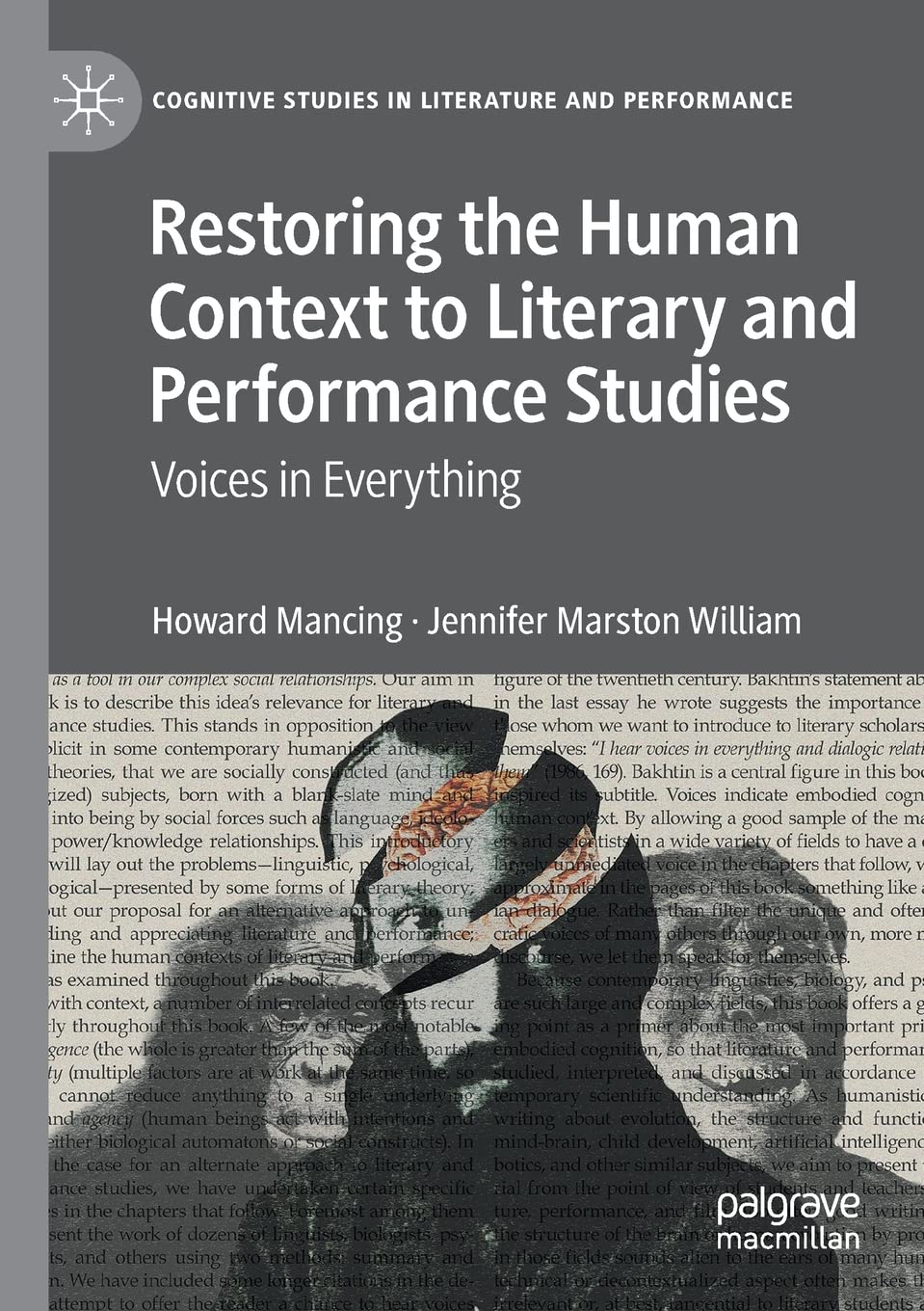
Restoring the Human Context to Literary and Performance Studies: Voices in Everything (Howard Mancing and Jen William, Palgrave, 2022, 400 pages) provides a comprehensive overview of the scientific principles underlying cognitive-literary studies and lays out the alternative approach of Contextualism as a new paradigm for literary and performance studies. The monograph has been cited for example by pioneering cognitive-literary scholar Lisa Zunshine, in her article "Don't Be Too Good at Reading Other People's Minds" (Emotion Review, International Society for Research on Emotion, vol. 16, no. 2, April 2024, pp. 117-26).
Other News and Events
Spring 2026
Guest Speaker
The Center for NeuroHumanities is excited to welcome Professor Fritz Breithaupt of the University of Pennsylvania to share his cutting-edge work on narrative, AI, and neuroscience.
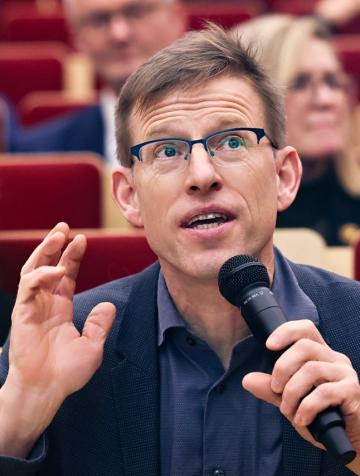
Professor Breithaupt, PhD in German Literature (1997) from Johns Hopkins University, bridges the humanities and cognitive science with his innovative work. He is the director of the Experimental Humanities Lab at Penn. We have enjoyed having him share his research with us at Purdue on several occasions already, such as at the first international conference on Theory of Mind and Literature, hosted by colleagues in the College of Liberal Arts in 2007.
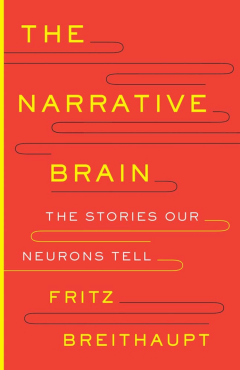
Professor Breithaupt recently published The Narrative Brain: The Stories Our Neurons Tell (2025, Yale University Press), which won the Science Book of the Year prize in Austria. In this monograph, Professor Breithaupt analyzes data from, for example, storytelling experiments with humans and with ChatGPT, and introduces a new form of human psychology oriented around our compulsion to tell stories.
Talk date, time, and place to be arranged.
Fall 2025
New Undergraduate Course!
LC 26500, Introduction to the NeuroHumanities
T/Th 3:00-4:15 in BRNG B254, Professor Paula Leverage (SLC)
LC 26500, Introduction to the NeuroHumanities, has its debut offering this semester! LC 26500 introduces students to the main developments in the neurohumanities particularly since the 1990s, with focus on cognitive literary and cultural studies. The course emphasizes not only the role of psychology, neuroscience, evolutionary biology, and other STEM and social scientific fields in interpreting cultural artifacts, but also how literary and cultural studies contribute significantly to those fields. Students will learn skills which will enable them to consider and interpret works of art, broadly defined, through a highly interdisciplinary cognitive-studies lens as they explore how the humanities are intricately intertwined with the sciences.
LC 26500 will be offered about once per year and is open to students of all majors (no prereqs).
Fall 2022
SLSA Conference Recap
Reading Minds: Artificial Intelligence, Neural Networks and the Reading Human
SLSA 2022, Purdue University, College of Liberal Arts
The 35th annual meeting of the Society for Literature, Science, and the Arts (SLSA) took place October 6-9, 2022 at Purdue University in West Lafayette, Indiana. Professor Paula Leverage, Director of the Center for NeuroHumanities and Associate Professor of French in the School of Languages and Cultures, chaired this very successful in-person event with about 200 attendees, as Purdue and the world was coming out of the COVID-19 pandemic.
The description of the conference's significance, as stated in the Call for Papers, was as follows:
Engaging scholars of literature, science and the arts in questions pertaining to the nature of reading inevitably suggests new lines of enquiry which extend beyond disciplinary fields, and reach to apprehend the “grand challenges” of the twenty-first century. Historically, the definition of reading has been narrowly defined as a human mind deciphering text, as written traditions of communication replaced the oral. With machine learning, natural language processing, and imaging, both the understanding of “reading” and “mind” are in flux. Over the course of the pandemic, the pivot to remote work and social distancing have led to an augmented virtual experience with the attendant consequences of new patterns of reading and an accumulation of data from that engagement.
The conference featured three stellar keynote speakers: artist and researcher Anna Ridler; writer and founder of the Artists + Machine Intelligence program at Google A, K Allado-McDowell; and theoretical physicist Donald Spector. In addition, the conference featured papers, panels, workshops, and creative work from scholars of many fields and institution who addressed, for example, the following topics:
* Artifacts of reading: print and digital
* The embodied mind problematized from the perspective of AI
* Natural language processing, especially machine translation and natural language generation.
* Neuro networks: human, animal and other organisms
* Data mining and data mine analysis
* Imaging and reading images, especially reading images of the brain / mind
* Cognitive processes of reading, and how they relate to the construction of meaning
* Theory of Mind in relation to reading, data mining and algorithms
* Empathy, and its simulation, through cognitive and affective lenses
* Creativity and computer-assisted processing and generation of art and literature
* Critical discourse in academia in the context of increasingly sophisticated algorithmic reading, the digital humanities: future directions and caveats
The SLSA 2022 program is archived on the conference website: https://litsciarts.org/slsa2022/.
Fall 2019
Measuring the Impact of Narrative, Humanities and the Arts
On November 12th, The Center for the NeuroHumanities held a colloquium, "Measuring the Impact of Narrative, Humanities, and the Arts: A Showcase of Current Research at Purdue." The colloquium brought together people from different departments in order to discuss some of the most recent research in NeuroHumanities. Afterwards, participants and attendees alike enjoyed refreshments in the newly remodeled media center in Stanley Coulter 220. Presentations included:
Cognition, Narrative, and the Human Reader
Paula Leverage, School of Languages and Cultures
Reading narrative text recruits the multiple cognitive processes of everyday human interaction with the environment, but with variation in the weighting assigned to each. By isolating and analyzing individual processes, we advance understanding of how, and why, narrative engages human cognition, and the implications for its functionality in society.
Measuring Fear in the Reader’s Mind and the Effects of Language Translation
Dan Foti, Psychological Sciences, and Clotilde Landais, School of Languages and Cultures
Drawing upon methods from affective neuroscience, we examine how the brain processes horror fiction in real time in order to measure the level of fear the subjects experience when reading horror fiction. We wish to evaluate the effectiveness of the strategies implemented by the authors of such fiction and to find out if the nature or the level of fear vary according to the language of reading (native or second language, original or translation).
Students’ Empathy and Flash Fiction in Spanish
Tyler Gabbard-Rocha, School of Languages and Cultures
An increasing amount of research in the neurohumanities indicates that there is a correlation between having read literary fiction and holding more pro-social, egalitarian, and empathetic world views – some argue that this is because fiction provides a sort of mental training ground for our mind where we can practice and develop our empathetic abilities. However, this research is often limited to a correlational conclusion, but does not explain how or why: are empathetic people more likely to read, or does reading actually cause an increase in empathetic abilities? My research looks at the development of empathy in undergraduate students in an Introduction to Hispanic Literature course.
Measuring the Magic of Theatre
Amanda Mayes, Office of the Vice Provost for Student Life, and CLA Cornerstone
Theatre is magical. For a few hours, we sit down and are completely immersed into a different world. The performances we see promote connections with the actors on stage and fellow audience members. Theatre transports us to different places and times and introduces us to unique perspectives. Those of us who love live performance believe in the magic of theatre. But how do we convince others? This presentation will highlight research demonstrating the measurable benefits of live performances.
Humanities and Human Flourishing: Conceptual Development and Assessment
Louis Tay, Psychological Sciences
I will be presenting empirical work from the Humanities and Human Flourishing project led by Dr. James Pawelski at Penn. We developed a conceptual framework describing the possible psychological mechanisms (RAISE: reflection, acquisition, immersion, socialization, and expressiveness) by which the arts and humanities may lead to human flourishing. New measures for these psychological mechanisms are being developed and will be rolled out as a toolkit.