New Research Labs in Political Science
The Political Science Department at Purdue University is home to a growing number of research labs and programs that support collaborative, interdisciplinary research among faculty, postdoctoral researchers, and graduate and undergraduate students.
These initiatives connect scholars across disciplines and colleges to address complex questions about technology, governance, democratic institutions, law, conflict, political attitudes, and political behavior. They also advance innovative research tools and methods, including audio and video analytics, computational methods, latent-variable measurement, experimental methods, and causal inference.
These labs build research capacity while creating opportunities for graduate and undergraduate students to develop research skills and gain experience leading projects. Such opportunities are especially important for scholars from backgrounds traditionally underrepresented in academia. The value of these experiences is reflected in recent research by Purdue Political Science graduate student Owura Kuffuor and colleagues, published in PS: Political Science & Politics. Their article, “Undergraduates and Political Science Research: Insights from Research Assistants in a Minority-Serving Institution Lab,” finds that participation in research labs can transform students' views of research while strengthening their professional skills and preparation for advanced study.
The department has also established an undergraduate Research Collaboratory, which allows students to earn academic credit while working with faculty on research projects or participating in one of the department's research labs.
Department Research Labs
- Computational Social Science Lab – Directed by Dr. Bryce Dietrich, this lab uses computational, empirical, and experimental methods to understand mass and elite behavior, with a particular focus on data from nontraditional sources, including audio and video. Its interdisciplinary team includes researchers from Political Science, Computer Science, Communication, Psychology, Sociology, and Statistics. Current projects use sources such as the C-SPAN archives, political advertisements, social media, and pedestrian interactions captured by publicly available traffic cameras.
- Governance and Responsible AI Lab (GRAIL) – Directed by Dr. Kaylyn Jackson Schiff and Dr. Daniel Schiff, GRAIL supports research on the social, ethical, and governance implications of artificial intelligence. The lab brings together faculty and graduate and undergraduate students for collaborative, interdisciplinary research and the development of rigorous, policy-relevant work on AI.
- Joe and Maggie Kearns Experimental Social Science Lab – Co-directed by Dr. Tara Grillos (Political Science) and Dr. Trent Mize (Sociology), this lab was jointly founded by the Sociology and Political Science departments. It provides space and equipment for conducting laboratory experiments, consulting facilities, and workspace for research groups and affiliates. The lab also serves as an interdisciplinary hub for sharing research and developing new projects.
- Law and Conflict Research Lab (LAC) – Directed by Dr. Liana Eustacia Reyes, JD, PhD, the LAC supports research on the implications of law for armed intrastate and interstate conflict, governance, foreign policy, and peace processes. Its work draws on diverse theoretical perspectives and methodological approaches to produce rigorous, policy-relevant research. Faculty, graduate and undergraduate students, and practitioners conduct both individual and collaborative research within and beyond Political Science.
- Program on American Institutional Renewal (PAIR) – Directed by Dr. Jesse Crosson and Dr. Logan Strother, PAIR advances the generation, communication, and use of knowledge about the workings of American governing institutions. It brings together scholars, students, and practitioners interested in improving the functioning of legislatures, courts, executive agencies, and other institutions. PAIR organizes programming for the broader Purdue community, connects students with research opportunities, and houses two research labs:
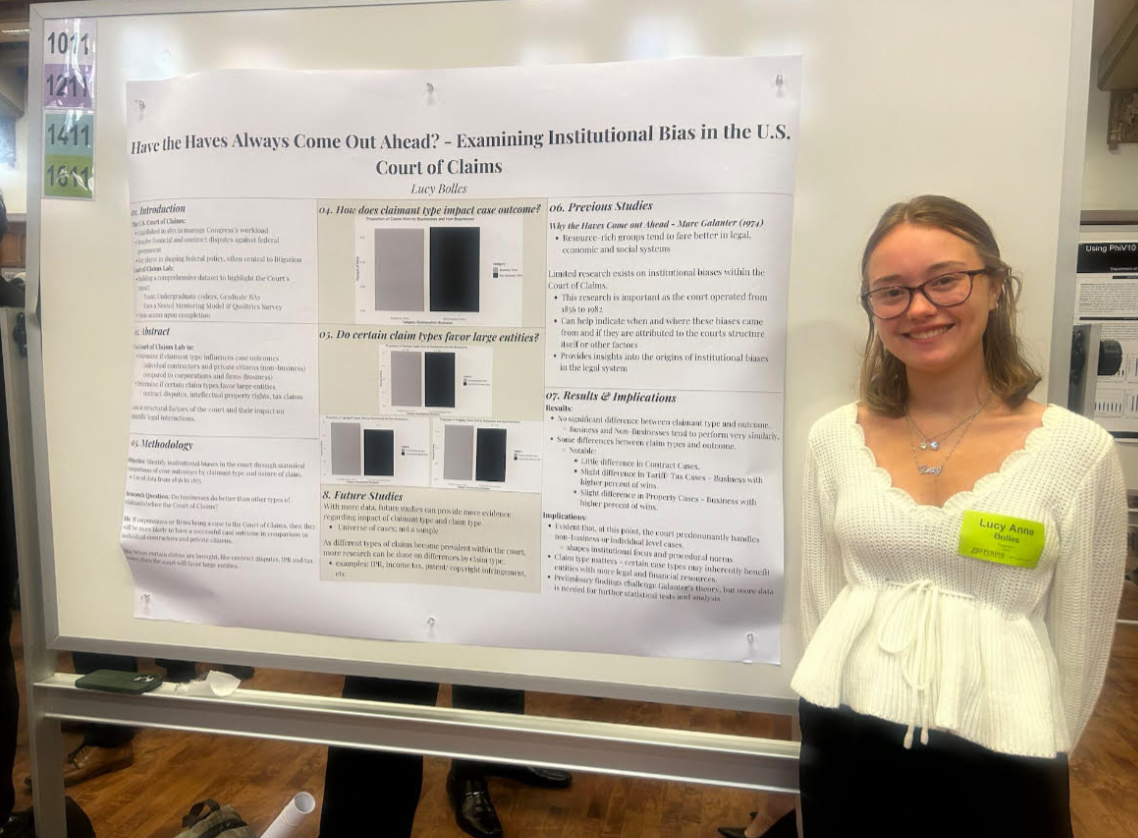
- Court of Claims Lab – Directed by Dr. Logan Strother, this lab studies the United States Court of Federal Claims, an important but understudied federal court. Faculty, graduate students, and undergraduate students are compiling data on every case the court has decided throughout its more than 170-year history. Once complete, the Court of Claims Database will be publicly available to researchers.
- Parties, Polarization, and Pluralism Lab – Directed by Dr. Jesse Crosson, this lab conducts a multiyear data collection effort examining whether organized interests, political parties, and American democracy support a pluralist system of pragmatic coalitions formed on an issue-by-issue basis. Researchers analyze primary-source data from the U.S. Congress and its members to understand the evolving relationships among legislators, political parties, and interest groups. The lab brings together faculty and students at Purdue and beyond.