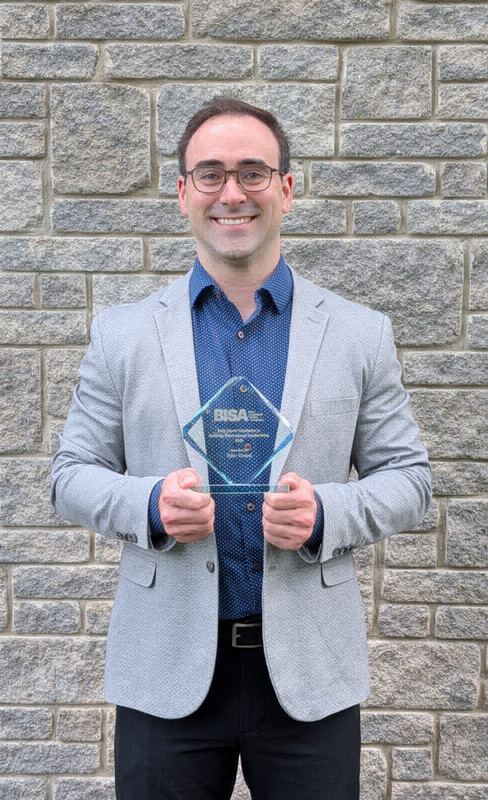
Congratulations Dr. Girard, BISA Early Career Excellence in Teaching Award!
Dr. Tyler Girard was awarded the British International Studies Association (BISA) 2026 Early Career Excellence in Teaching International Studies Prize, which recognizes early career academics who have contributed to the positive learning experience of students in International Studies within the first five years of their career.
In the words of the BISA judging panel: "Tyler’s nomination reflects an excellent and wide-ranging contribution to international studies pedagogy. His use of innovative teaching methods such as simulation exercises, and broad contribution across numerous modules is indicative of his contribution. The judging panel were particularly impressed by Tyler’s development of study abroad international partnerships with the University of Glasgow, his work as an advisor on Purdue’s Model UN club and Pi Sigma Alpha, and chair of dissertation committees. His contributions exemplify an outstanding early career pedagogical profile, and the panel were pleased to endorse his nomination for this award."
Dr. Girard received the Purdue Department of Political Science Outstanding Graduate Teacher Award in April 2025 and the Kenneth T. Kofmehl Outstanding Undergraduate Teaching Award in April 2026. The Kofmehl Award is the highest teaching award given by Purdue’s College of Liberal Arts.
Professor Girard is a core faculty member of the Governance and Responsible AI Lab (GRAIL) and an affiliate at The Methodology Center at Purdue (MCAP). He received a Ph.D. in Political Science from the University of Western Ontario in 2021. In recognition of his dissertation and academic achievements, he was awarded the Governor General’s Gold Medal. Prior to joining Purdue, he was a SSHRC Postdoctoral Fellow in the Department of Political Science at Duke University.
Girard’s research explores the political economy of digital technologies and technological change, the promotion of global norms and agendas, and methodological issues of measurement and scaling. In his book, Financial Inclusion: How and Idea Became a Global Agenda (Stanford University Press), he explains the evolution of the global financial inclusion agenda through the participatory construction of ambiguity by transnational communities. His research is published or forthcoming in the American Political Science Review, International Studies Quarterly, the Review of International Political Economy, among others.