AI in the Arts: Where Creativity Meets Computation
A cellist adjusts her posture between lessons, unsure if her hands are positioned correctly.
A centuries-old painting hangs in a chapel, its origins still debated after 400 years.
In both cases, the question is the same: how do we better understand human expression?
At Purdue University’s College of Liberal Arts, researchers are turning to artificial intelligence to find answers.
Aiding Beginning Musicians
Dr. Kristen Yeon-Ji Yun, a clinical associate professor in the department of music, didn’t start in technology, but on a stage.
“I’m a cello performer. I have a bachelor's, master's, and doctorate in cello performance,” she said. “I’m just really a music-centered person.”
But as AI became more prevalent, she began to see new possibilities.
“AI is part of our life,” Yun said. “So, I started to think about how AI can help us.”
What began as an idea of pairing live performance with AI-generated visual elements quickly grew into something larger.
“It’s about multimodality,” she said. “The music and accompanying images will satisfy the various senses. I think we are creating a new kind of art.”
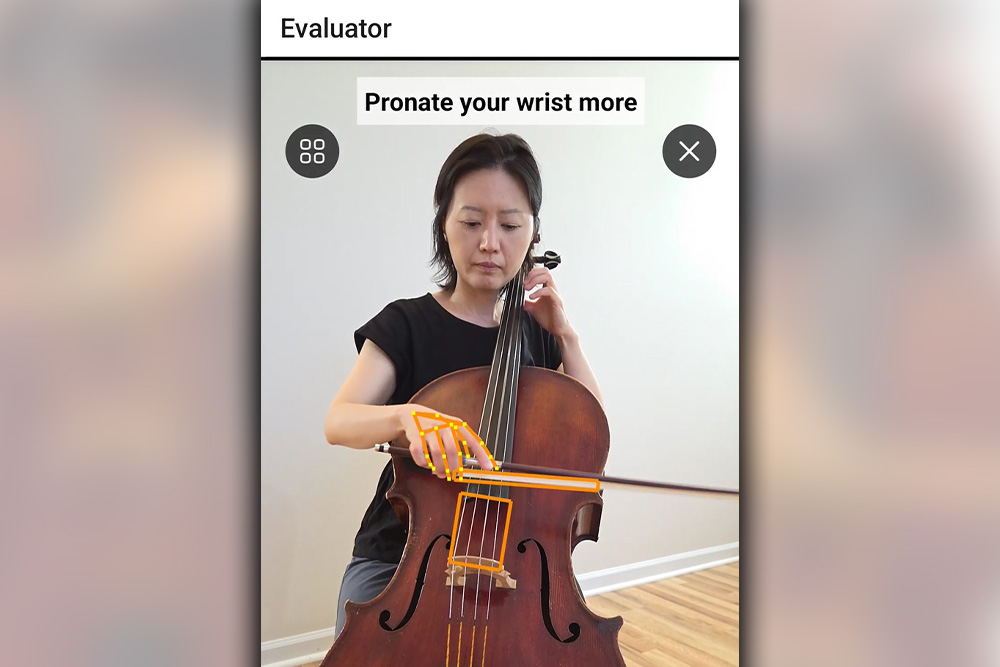
That same thinking led to her latest project funded by the U.S. National Science Foundation, which explores how AI can support musicians as they learn and practice. Her team developed tools that analyze posture and sound, enabling musicians to refine their technique in real-time. This matters most in the moments when a teacher is not there.
“Cello lessons are weekly lessons,” Yun said. “So that means for beginners, between the lessons, they don’t know actually what is the right posture.”
That’s where AI comes in as a bridge between the teacher and student.
“AI cannot really become the teacher itself,” she said. “However, AI can be a tool to help and assist our teaching.”
In early testing, that support proved especially meaningful. Beginners benefited the most from the technology, gaining feedback that would otherwise be unavailable between lessons.
For Yun, the goal is not to automate artistry, but to protect and strengthen it. She sees AI as a way to amplify what artists already do best.
“Human interpretation is going to still be very important,” she said. “The musicality is actually a human decision. AI can help our productivity and also creativity. We just need to accept it as a tool.”
Solving a Centuries-Old Question
In another area of study, Andrew Van Horn, a QuantLab postdoctoral fellow in the anthropology department, is asking a different question, rooted in art history rather than performance.
Who really painted a masterpiece?
For centuries, scholars have debated the origins of El Greco’s “The Baptism of Christ,” a work long believed to have been completed by multiple hands after the artist’s death. Traditionally, answers depended on trained observation.
“It was sort of a skill that certain art historians tried to develop, this ability to look at how a painting was done and be able to tell who or how they did it,” Van Horn said.
The 10-year gap between El Greco’s death and delivery of the painting and a general lack of records for the day-to-day operation of his workshop gave way to questions and theories to the painting’s true creator. Thus far, traditional methods have been unable to provide answers.
That’s where AI offers a new lens.
“It’s a tool that extends our ability to see and to process,” Van Horn said. “It lets us see things at a scale that we really can’t see with the naked eye.”
Instead of training AI in the usual way by feeding the model thousands of labeled examples, Van Horn and his collaborators designed a method that learns from what the system cannot do.
“If it can’t learn how to tell the difference between the examples, then they’re the same,” he said.
By applying that method to high-resolution scans of the painting, the team uncovered unexpected connections across different regions of the work. Those connections suggest that the painting may not be as collaborative as once believed.
“We’re just kind of muddying the waters, throwing a wrench in things,” Van Horn said.
The result does not close the case. Instead, it reframes the question by offering new evidence in a debate that has lasted centuries.
But for Van Horn, the real breakthrough is not just what they found. It is how they found it.
“The combination of using AI as a tool to solve problems and to answer questions in the humanities is what makes this kind of a creative force,” he said.
The Human Element of AI
That creative force depends on something deeper than technology alone.
Both Yun and Van Horn emphasize that AI is most powerful when artists, historians and researchers shape the questions it is used to answer.
“You need the input of humanities scholars to really keep you on track,” Van Horn said.
That perspective is increasingly important as AI continues to evolve. In fact, he sees the humanities playing a central role in the future of AI.
“I think people who have a background in the humanities and social sciences are going to be increasingly driving AI-based innovation,” he said.
Together, their work reflects a growing reality that the future of AI will not be shaped by technology alone, but by the people asking creative, human-centered questions about how it can help us better understand art, history and one another.