LSP banner with three images. One has a clipboard and medical tool, the next has an astronaut, and the last has people in a research room.

Languages for Specific Purposes

The Department of Classics offers the following courses in Languages for Specific Purposes:

  • CLCS 234 - Medical and Scientific Terminology from Greek and Latin Roots: Ninety to ninety-five percent of scientific-technical vocabulary and medical terminology come from Latin and Greek roots and affixes. This course will enable students in scientific and medical disciplines to develop a foundational core of Greek and Latin roots and affixes from which they will be able to decipher and easily commit to memory the core terminology in the various sciences and medicine.

  • CLCS 385 - Science, Medicine, and Magic in the Ancient West: Study of the development of the idea of rationality in the West through the examination of the evolution of Greek and Roman sciences, with emphasis on medicine and astronomy.

For more information or questions about Classics for Specific Purposes courses, please contact Elizabeth Mercier ().


France is not solely about fashion and cuisine; the country is also a leader in science, technology, architecture, and diplomacy. Fluency in French and intercultural literacy can thus lead to careers in business, engineering, hospitality, medicine, the arts, etc. In 2018, French companies created more than 600,000 jobs in the U.S. and almost 30,000 in Indiana alone. To help students develop global perspectives sought by U.S. companies and NGOs over the world, we offer modules called "French and Engineering" as part of general French courses as well as four courses in French for Specific Purposes.

Courses in French for Specific Purposes:

Topics covered in our courses include France’s major industries and companies, understanding and discussing aspects of the French market economy, marketing, intercultural communication in French-American business settings, writing administrative correspondence in French, and applying for internships and jobs in Francophone countries.  Our goal is to develop students’ communicative and intercultural skills in a variety of speaking or writing activities toward the use of French for professional purposes.

French for Specific Purposes at Purdue consists of three courses for professional purposes, beginning after the completion of the fourth semester of French (FR 202: French level 4 or equivalent). 

These three courses (FR 224, FR 324 and FR 424) can be taken independently or as part of the Minor in Professional French. 

  • FR 22400: Professional French Level I: Practical reading, writing, speaking, and listening comprehension skills will be developed toward the use of French for professional purposes. Course materials cover daily business dealings as well as national and international trade.  
  • French for Engineering: Through the continued development of French-speaking, listening, reading, and writing abilities, students work on the French language and culture in documents related to Engineering. 
    Topics include the study of Engineering in France, and French Engineers' functions and ethics. They also cover case studies, such as the Channel Tunnel, the TGV (the world's fastest train), and the viaduct of Milau, among others. Students will learn about women in science, concentrating on areas such as the discrimination of female scientists and the lives and work of engineers like Jocelyn Bell, Margaret Hamilton, and Sophie Germain. 
  • FR 32400: Professional French Level II: Practical reading, writing, speaking, and listening comprehension skills at an intermediate level will be developed toward the use of French for professional purposes. Course materials cover daily business dealing as well as national and international trade.
  • FR 42400: Professional French Level III: A study of the terminology and techniques used in commercial transactions, including the interpretation and writing of business materials. Development of the four language skills, with emphasis on writing and speaking. 

For questions about the French for Specific Purposes courses, please contact Dr. Ana Valero Peña ().

Fluency in German and intercultural competence greatly improve students’ opportunities in careers in business, science, and engineering.

In 2018, 5,300 companies with headquarters in Germany employed more than 700,000 Americans. In Indiana, Germany is the second-largest foreign investor. Overall, Germany has the third-largest economy in the world and is the third-largest exporter. American companies with operations in Germany are often in need of employees with German language skills and intercultural competence.

The German department offers five German courses for Specific Purposes to help students further develop their language and intercultural skills and gain global perspectives - qualifications sought by many international businesses and organizations. Three of these courses focus on Business German while two courses focus on Scientific German. We also offer the possibility for students to obtain a 15-credit Certificate of German for Specialized Purposes. 

Courses in German for Specific Purposes:

Scientific German

  • GER 223 - Scientific German: Practical reading, writing, speaking, and listening comprehension skills, directed toward the use of German in science and technology. Work on grammar as needed. Use of materials from recent publications in science and technology. Introduction to general and technical vocabulary. Conducted primarily in German. Credit will not be given for both GER 20200 and 22300. Pre-req: GER 201
  • GER 323 - German for Science and Engineering: Continued development of German-speaking, listening, reading, and writing abilities, using materials from recent publications in science and technology. Building of general and technical vocabulary. Conducted in German. This course is an alternative to GER 302.  Pre-req: GER 301

Business German

  • GER 224 - Business German: Practical reading, writing, speaking, and listening comprehension skills directed toward the use of German for business purposes. Work on grammar as needed. Course materials cover daily business dealings as well as national and international trade, living conditions, and environmental and social problems. This course is an alternative to GER 202.  Pre-req: GER 201
  • GER 424 - Business German: A study of the terminology and techniques used in commercial transactions, including the interpretation and writing of business materials. Development of the four language skills, with emphasis on writing and speaking. Pre-req:  GER 302
  • GER 524 - German for International Trade: A broad spectrum of business and cultural materials to prepare students for work in international firms. Intensive study of technical terminology used in business transactions; stylistics in business correspondence and report writing; training for accurate oral expression in business negotiations. Pre-req: GER 424

For questions about the German courses for specific purposes, please contact Dr. Marc Rathmann ( ).

The Department of Russians offers the following courses in Languages for Specific Purposes:

  • LC 101: Russian for Rocket Scientists: LC 101 is an introductory Russian language course themed around space exploration and space technologies. The course features working with authentic Russian space program materials, including texts, documents, videos, anecdotes, and other cultural resources. The learning objectives include: i) developing basic Russian language skills: speaking, reading, writing, and listening; ii) building scientific and technical vocabulary.
  • RUSS 424 - Business Russian: RUSS 424 deals with various aspects of Business Russian and Russian Business. The course is aimed at acquiring the skills and knowledge necessary for successful communication with Russian business partners. The course covers major business concepts, in particular, transactions regularly conducted in business offices, including business letters, inquiries, offers, and contracts. Students will also discuss Russian etiquette and ethics in business. Instructor: Dr. Olga Lyanda-Geller
  • RUSS 498 - Technical Russian: Russian for Scientists and engineers: While continuing to work on their proficiency in the Russian language, students taking this multidisciplinary course will learn about history of Russian science and current scientific and engineering technologies. Russia continues to be one of the leading powers in mathematics and many areas of natural sciences, and the ability to foster collaboration with Russian partners and to have a direct access to authentic materials in Russian can spur significant scientific and technological breakthroughs. The course is designed for students with an intermediate to advanced level of Russian and will introduce a wide range of historical and technological topics and the associated Russian language vocabulary.

For more information or questions about the Russian for specific purposes courses, please contact Dr. Olga Lyanda-Geller ().

Spanish is spoken as the first language by 400 million people worldwide and 33 million speakers in the USA, which makes it the second most-spoken language in the USA. The demand for professionals who speak Spanish fluently is growing across the nation. Fluency in Spanish can lead to careers in business, engineering, hospitality, medicine, the arts, and other fields. To help students develop global perspectives and professional skills in a second language, we offer eight courses in Spanish for Specific Purposes, as well as a Minor in Spanish for the Professions.

Topics covered in our courses include the use of Spanish in professional and formal situations, understanding and discussing aspects related to work environments, intercultural communication in Spanish-speaking settings, and applying for internships and jobs in Spanish-speaking countries. Our goal is to develop students’ communicative and intercultural skills through a variety of speaking or writing activities toward the use of Spanish for professional purposes.

Courses in Spanish for Specific Purposes:

  • SPAN 224 - Basic Spanish for Business and Finance (counts as SPAN 202): Introduces essential business vocabulary and Notas culturales written from a cross-cultural perspective. It provides students with opportunities to apply, in a wide variety of practical contexts, the grammatical structures presented in the corresponding lessons of the Basic Spanish core text.
  • SPAN 321 - Introduction to Spanish for the Professions: Continued work at the advanced-intermediate level with a focus on vocabulary and grammar for contexts in a wide variety of professional settings. Conducted primarily in Spanish. 
  • SPAN 322 - Spanish for the Health Professions: Intermediate level course directed towards the use of Spanish in the health care professions. It covers specialized vocabulary from the medical fields, as well as grammar and syntax with the goal of developing speaking, listening, reading, and writing abilities. Students will have the opportunity to apply their skills in practical contexts and discuss cultural considerations. 
  • SPAN 323 - Global Sustainable Engineering: The primary goal of this course is to engage students in the humanities and provide collaborative interdisciplinary learning opportunities for engineering and liberal arts students. It is based on a case study approach that analyzes engineering endeavors from around the world, focusing on how decisions and projects affect local people and places. Each case study provides the opportunity to solve problems from both, a humanistic and an engineering perspective.
  • SPAN 325 - Spanish for Engineering and Technology: Intermediate level course directed towards the use of Spanish in the Engineering and Technology professions. It covers specialized vocabulary from the technical fields, as well as communication and culture with the goal of preparing students for an intercultural working environment. Students will further develop their speaking, listening, reading, and writing abilities. They will have the opportunity to apply their skills in practical contexts and discuss cultural considerations, as well as meet professionals from Spanish-speaking countries. 
  • SPAN 415 - Spanish Translation and Interpreting: Introduction to the Translation and Interpretation Studies field for Spanish speakers. A high level of competence in Spanish is required. Overview of translation theory, methodology, and practice both in class and in real settings. Includes a service-learning component. Conducted in English and Spanish. 
  • SPAN 424 - Business Spanish: A study of the terminology and techniques used in commercial transactions, including the interpretation and writing of business materials. Development of the four language skills, with emphasis on writing and speaking.
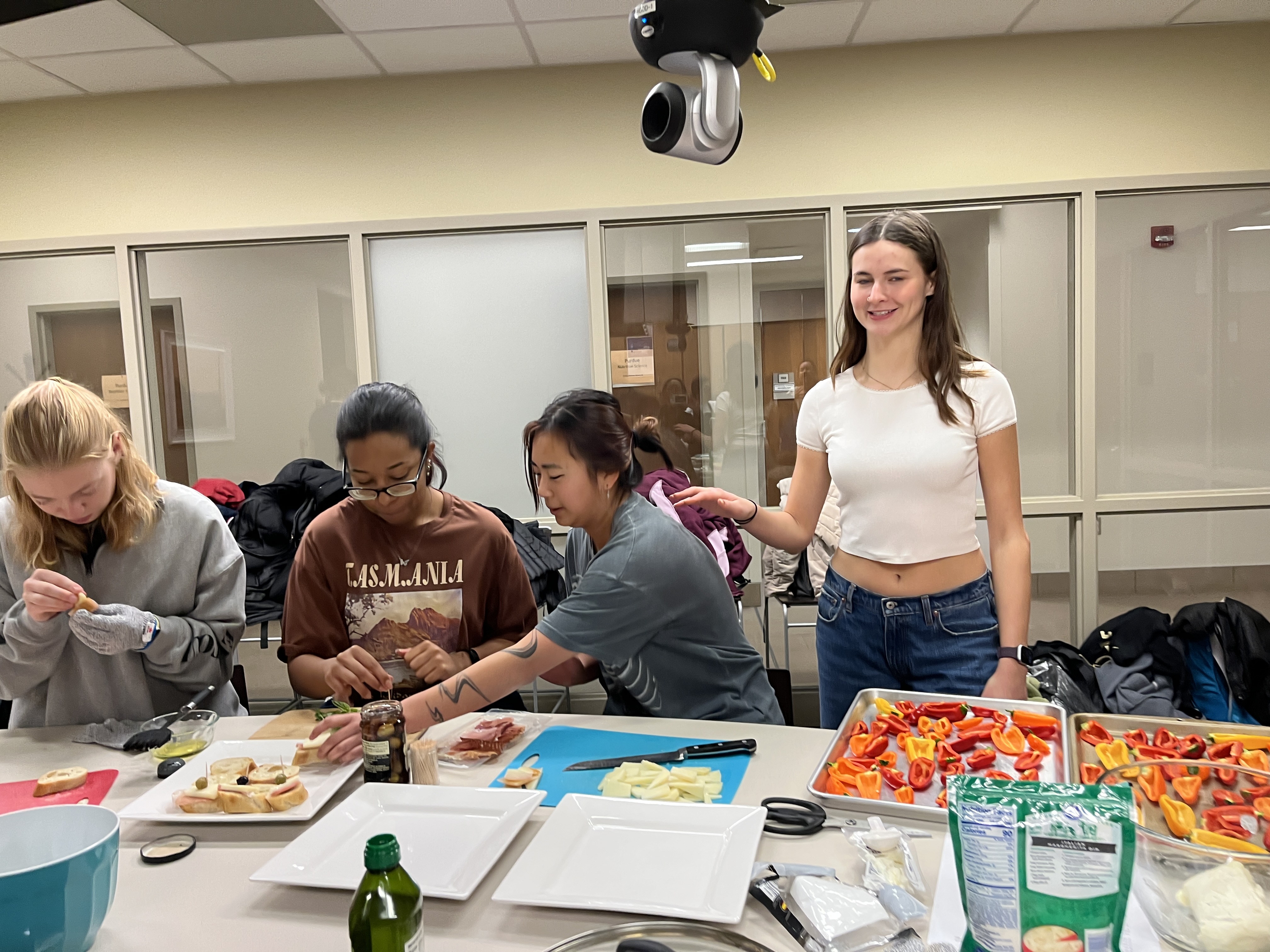
  • SPAN 485 - Food and Culture in the Hispanic World: Advanced-level language and culture course about food culture in the Spanish-speaking world. It covers gastronomy, celebrations, history, art, mythology, and other aspects of daily life related to the culinary traditions of the Hispanic countries. Students will further develop their speaking, listening, reading and writing abilities in Spanish. They will have the opportunity to apply their skills in practical contexts and discuss cultural considerations, as well as participate in some hands-on cooking experience.

For more information or questions about the Spanish for specific purposes courses, please contact Cecilia Tenorio ( ).

In this era of world communications and cross-cultural interactions, students need to be ready for professions that require specific intercultural skills and language competencies.  

The School of Languages and Cultures (SLC) offers more than a dozen language courses in the area of Languages for Specific Purposes (LSP). These courses address the needs of language students in specialized professional fields and focus on business, science, medicine, engineering, agriculture, and translation and interpreting.

Through the study of specialized vocabulary and by participating in hands-on activities such as role-playing, students acquire the language skills needed to conduct business, interact with patients or clients, or take part in other formal situations in their future careers.

Many of our LSP courses are approved courses for the   or the CLA Science and Technology Studies Certificate.


LSP instructors participate in a variety of conferences that foster advocacy, leadership development, professional impact, and meaningful connections within the field. These include International Conference of the Slovene Association of LSP Teachers, ISLSP / CIBER Business Language Conference, a the Annual Colloquium on International Engineering Education (ACIEE).


LSP Co-Directors | Marc Rathmann

LSP Co-DirectorsCecilia Tenorio