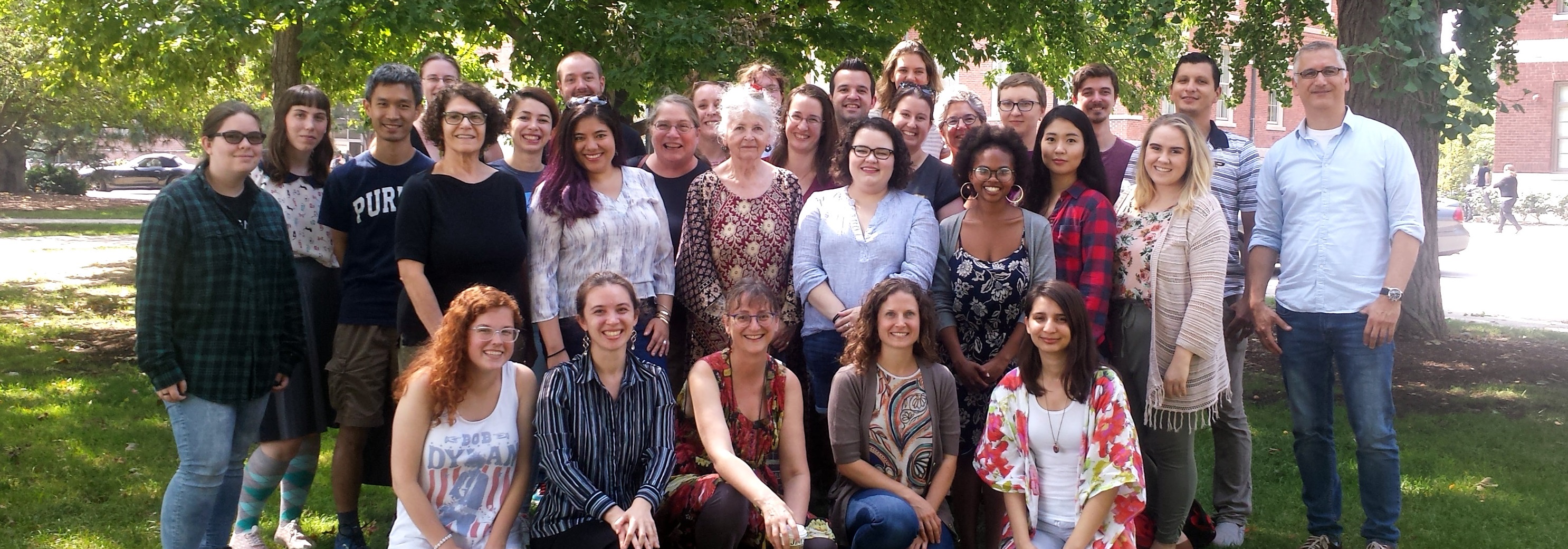
Linguistics involves the scientific study of language structure, how humans acquire and use language, and how languages change. The Department of Linguistics at Purdue will help you develop the skills necessary to analyze any language and to understand the role language plays in societies around the world. Our courses cover methods for analyzing language, role of languages in society, word formation processes, mechanisms of speech production, and more. The department also offers a minor in Linguistics.
The mission of The Department of Linguistics at Purdue University aims to advance the understanding of the human language capacity in its social, cognitive, and historical dimensions, through excellent undergraduate teaching, comprehensive graduate training, and innovative faculty and student research spanning the major linguistic subfields. We embrace an interdisciplinary approach to the scientific study of language structure, language acquisition, bilingualism, and language use. In doing so, we employ a variety of theoretical perspectives and methodological tools in our research, and we provide a diverse range of perspectives and experiences for our students to explore.
We believe that a rich learning environment offers not just varied theories and methods, but also a space that embraces and welcomes everyone. We're dedicated to cultivating an environment where all individuals feel valued and can fully participate. This commitment is apparent in our teaching, in our interactions with students and colleagues, and in our research and community outreach activities, especially as related to the language varieties of immigrants, indigenous communities, Deaf communities, and other underrepresented groups.
Purdue's Department of Linguistics is distinguished by a strong applied focus after thorough theoretical training. Our graduate students apply theory while studying areas like bilingualism, language acquisition, corpus linguistics, natural language processing, and sign languages. Our many on-campus linguistic labs provide opportunities for research and collaboration.
WHY LINGUISTICS?
Linguistics studies the properties that characterize human language and its interactions with other cognitive and social systems. In contrast with other disciplines that also deal with language, linguistics uses the scientific method to address the questions around the nature of language in humans.
Some students chose to major in linguistics, others find the linguistics minor to fit in well with their other studies. Whether you are interested in language teaching, cognitive science, social research, natural language processing, speech pathology, or the technical details of how language works, you will find the Linguistics courses intriguing and helpful.
WHAT WILL I STUDY?
- You will learn about many aspects of human language, including sounds (phonetics, phonology), words (morphology), sentences (syntax), and meaning (semantics). You will also learn how languages are acquired, and the sociolinguistic and psycholinguistic nature of that process.
- You will look at how languages change over time (historical linguistics), as well as issues related to language contact and bilingualism.
- You will learn how language varies from situation to situation, group to group, and place to place (sociolinguistics, dialectology).
- You will learn how people use language in context (pragmatics, discourse analysis).
EXPERIENTIAL LEARNING
- Students have the opportunity to participate in short-term and long-term study abroad courses in Europe, Mexico, Central America, and Latin America - learn more in our study abroad page
- Students have the opportunity to participate in service learning courses
- Students regularly participate in professors' research
- Students are encouraged to publish their research in the Journal of Purdue Undergraduate Research
CAREERS
Our graduates have successfully found careers in:
- Education
- Government
- Law school
- Linguistic forensics
- Editing
- Curriculum Design
- NGO specialist for linguistic and cultural projects
- Linguistic consulting for World Development Programs
- Speech user interface design
- Linguistic consulting for Native American Institutions
- Linguistic consultant/specialist for school corporations
Visit our Facebook and Youtube pages and take a look at the linguistics labs on campus to get a feel for the department.