Liberal Arts Research: Studying How the Brain Interprets Ambiguous Language
When we read a sentence, we rarely stop to think about the complex mental work happening behind the scenes. Yet every word we process relies on a vast store of unconscious knowledge about how language works.
That invisible system is exactly what Dr. Kyle Swanson, associate director of the Oral English Proficiency Program (OEPP) as well as an affiliate of the Purdue Experimental Linguistics Lab and the Department of Linguistics, is working to better understand.
Swanson’s research, made possible through funding from the School of Interdisciplinary Studies, sits at the intersection of linguistics and cognitive science, asking a fundamental question: What happens in the mind as we interpret language in real time?
When Sentences Mislead Us
Language is filled with ambiguity. Some words carry multiple meanings. Entire sentences can shift interpretation depending on the intonation. Swanson’s current project focuses on syntactic ambiguity, when the same string of words can be analyzed in more than one grammatical way.
Consider a sentence like: I met the mother of the girl who taught herself to play piano. When English-speaking readers encounter the word “who,” they tend to assume it refers to the most recent noun, in this case “girl,” even though it could technically attach it to “mother,” instead. In sentences like I met the father of the girl who taught himself to play piano, the reflexive pronoun “himself” forces the brain to reconsider its initial interpretation and adopt a new one. The sentence is actually about the father.
By tracking how long it takes participants to read specific words, the researchers can identify what types of information the brain uses to revise its interpretation as well as pinpoint the exact moment that it does this.
“We’re trying to figure out how people use unconscious grammatical knowledge as they process language,” Swanson explained. “What happens when your brain expects one possible interpretation and then discovers it was wrong?”
To capture this process, participants read sentences one word at a time on a computer screen. The program records reaction times for each word. Even small delays, measured in milliseconds, reveal when readers encounter difficulty or need to reinterpret meaning.
Students at the Research Table
Some of the most important contributors of the project are the graduate and undergraduate students on the team.
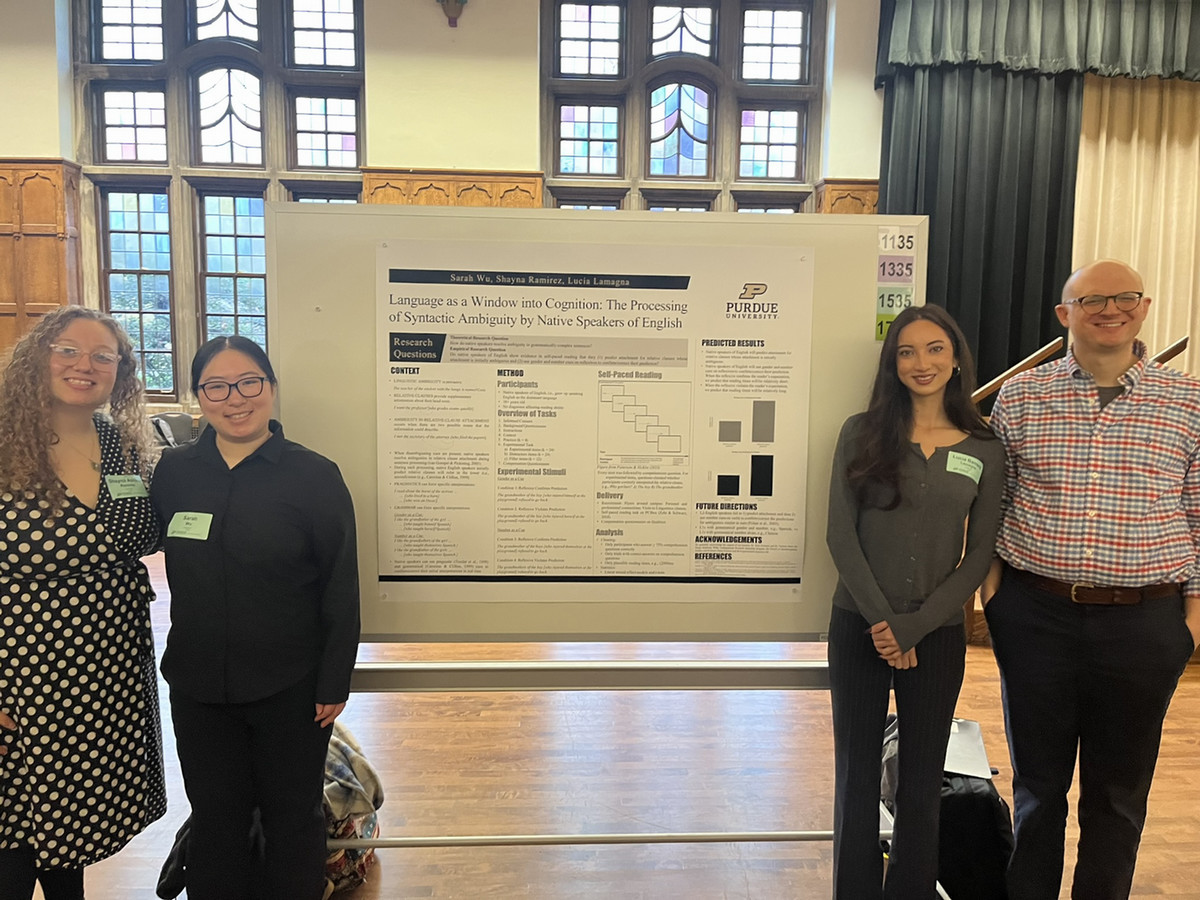
Recent PhD graduate Vanessa Sheu helped shape the experimental design early on. Through the Wilkie Internship program, three undergraduate students also joined the project in early fall: Lucia Lamagna, a Degree Plus senior majoring in speech, language, and hearing sciences and Spanish; Sarah Wu, a Degree Plus sophomore majoring in economics and law and society; and Shayna Ramirez, a junior studying anthropology with a minor in linguistics.
The interns began by recruiting study participants. From there, the students moved into stimulus writing, data cleaning, and preliminary analysis. Reaction time data is notoriously messy. Together, the team wrestled with questions like: How long is too long for someone to take to read a word? How short is unrealistically fast? What counts as meaningful engagement?
For Lucia, the analysis phase was the most challenging. Though she had experience with statistics, interpreting nuanced reaction-time data pushed her beyond her comfort zone. With Swanson’s mentorship, she learned to navigate deeper levels of interpretation.
Sarah found herself immersed in psycholinguistics and syntactic theory, reading foundational research far outside her usual coursework.
Shayna described the experience as invigorating. Studying how different speakers deal with linguistic ambiguity broadened her understanding of language processing, knowledge she sees as vital for future work in archaeology and anthropological research.
Across disciplines, the students shared one realization: liberal arts research can be technical, experimental, quantitative, and rigorous. It demands the same precision and analytical depth as any traditional STEM field.
Their dedication was proven when the team presented their research and early work at Purdue’s Undergraduate Research Expo last fall. The students prepared a professional research poster, distilled complex theory into accessible language, and fielded questions from judges and peers.
The students received high distinction for their work, the highest award in their category.
The Work Continues
This spring, the interns will help design new experimental procedures, write stimuli, and think carefully about every variable that shapes sentence interpretation.
For Swanson, the project demonstrates something powerful about undergraduate research. Students from different disciplines can step into a complex scientific conversation, deepen their understanding of the research process, and contribute meaningfully to expanding human knowledge.
“As speakers, we don’t know what we know about language,” he said. “It’s unconscious. Our research is trying to figure out those split-second decisions our brains make so we can begin to understand the system underneath.”
And sometimes, in the process of figuring out how sentences fall apart and come back together, students discover just how much they’re capable of building.