Inside the Living Lab of Liberal Arts
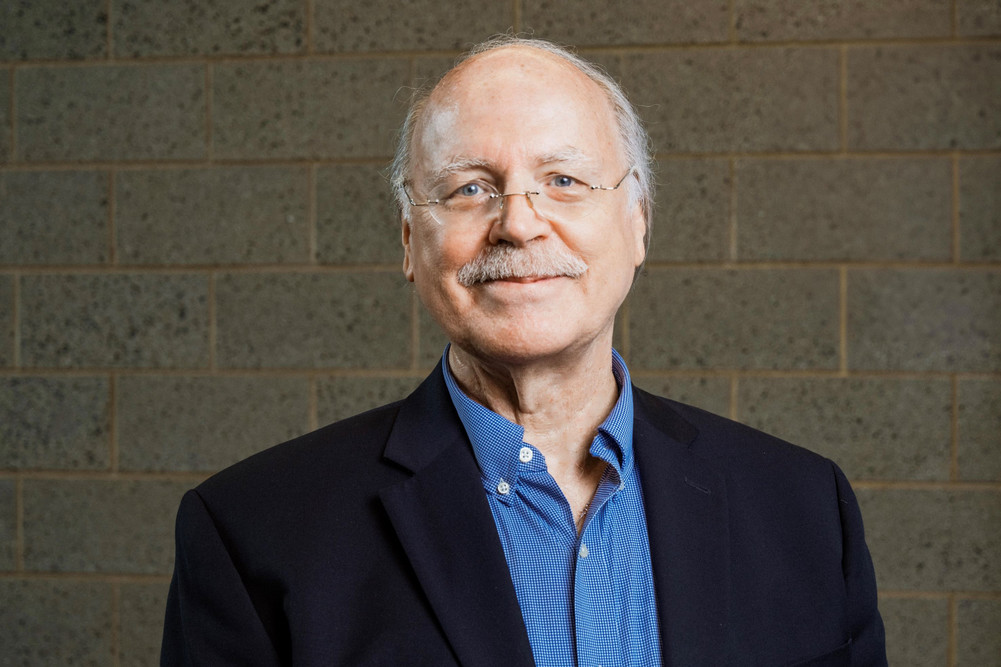
As he moves through the Degas Gallery at Purdue, Dean’s Research Professor of English Michael Shelden isn’t just pointing out the subtle shaping of a sculpture’s back or the tilt of a dancer’s chin. He’s embodying what exploration looks like inside what he calls the lab of the liberal arts. The gallery becomes a living laboratory, where observation, imagination and research intersect.
“These [sculptures] were not meant to be permanent,” Shelden says. “You’re privileged to kind of walk into an artist’s studio where everything is in half stages of experimentation. Degas saw them as works in progress, and they weren’t cast in bronze until after his death.”
His new book on the university’s Edgar Degas collection grew not from casual interest, but from immersion — reading 30 to 40 books and articles, a trip to Paris and reconstructing the cultural atmosphere around the art. He doesn’t just narrate Degas’ artistry; he recreates the world that shaped him.
“You put the reader in your footsteps,” he explains. “When you put your reader that close, life becomes richer.”
That philosophy defines both his writing and his teaching.
Scholarship as Speed, Discipline and Joy
He began the Degas project in October 2025 and plans to finish this May, a pace that reflects decades of refinement. He tells students plainly: “You can’t write a lot of books if you’re slow.” For Shelden, reading quickly isn’t about skimming; it’s about fluency. “Life is much richer when you can read faster,” he says. “Joy comes with the speed.”
That evolution didn’t happen overnight. Known for biographies of figures like George Orwell and Mark Twain, he has spent years learning how to enter someone else’s life with empathy and rigor. Writing about a visual artist expanded his approach. Instead of interpreting sentences, he had to interpret gesture, light and composition with the intended purpose of immersing the reader in the story behind it all.
Paris as a Creative Thread
Running parallel to the Degas book is a 150,000-word study of American writers in 1920s Paris, including Ernest Hemingway and F. Scott Fitzgerald. Where Degas represents 19th-century Paris, these writers inhabited the city as a laboratory of artistic reinvention.
For them, Paris offered freedom socially, financially and imaginatively. The myth of the “Lost Generation,” Shelden suggests, often oversimplifies what was really happening. It wasn’t about recklessness; it was about proximity to possibility.
That idea mirrors his own career. As a journalist, he traveled across Europe and the U.S. to conduct more than 250 interviews, from Gene Hackman to Robert Duvall. Those conversations taught him that creative breakthroughs don’t always follow neat, prescribed steps. Sometimes the best work emerges without a roadmap. Sometimes it requires the courage to take a chance on the right person or the right idea.
“In doing the work,” he says, “the enlightenment comes to you.”
Those years also reshaped his discipline. Writing to meet deadlines for the Daily Telegraph, he learned to produce 2,000 words at a time, often just hours after an interview. The pace left no room for hesitation and, eventually, no room for writer’s block. Creative confidence, he discovered, isn’t about waiting for inspiration; it’s built by showing up, doing the work and trusting that clarity will follow.
The Arts as a Laboratory
The most revealing moment comes to him on campus.
“Purdue provides a lab,” Shelden says. “It’s the classroom. It’s the library. Wherever I am on campus, I am in the lab.”
For a university known nationally for STEM, that metaphor matters. He pushes back gently against the idea that imagination competes with engineering or science.
“It’s not STEM versus us,” he explains. “We are all in a creative endeavor. We play with imagination while their work is more quantitative.”
In Shelden’s view, the humanities and STEM are engaged in the same essential act of gathering evidence, asking why and putting findings into writing to tell a story. Degas’ presence on campus becomes symbolic. If Purdue can house and interpret Degas, then Purdue becomes a champion for the imagination.
Impact on Students
Shelden’s research doesn’t sit on a shelf; it migrates into the classroom. Students watch him move from archive to argument in real time. They see what sustained curiosity looks like. They see deadlines met and learn that writer’s block loosens when you commit to the work.
Most importantly, they witness scholarship as lived experience. Not theory. Not abstraction. A practice.
In National Reading Month, that may be the quiet lesson: reading is not passive consumption. It is entry into another life, another city, another century. It is how you build the “360-degree view” Shelden seeks in every biography.
And at Purdue, that process is happening in the living lab where imagination is not ornamental, but essential.