HIST 492 World War I in the Middle East
Fall 2025
Place: BRNG 1268
Day and Time: M-W-F, 4:30-5:20 pm
Instructor: Professor Holden
Student Hours: W, 1-3 pm, and by appt. (BRNG 6166)
Email: sholden@purdue.edu
World War I made the Middle East what it is today. Controlled for most of the war by the Ottoman Empire and its German allies, this region was a major theatre of military operations. Fighting, famine, disease and the purposeful massacres of ethnic communities killed more than 5 million people, or 25% of the population (compared with 10-11% in England and France). After the war, Entente powers broke up the Ottoman Empire. The devastation wrought by World War I along with the postwar diplomatic brokering left a political and economic legacy that has yet to be fully untangled.
Class Requirements
Required Textbooks (check availability as e-book at Purdue):
- Eugene Rogan, The Fall of the Ottomans: The Great War in the Middle East (Basic Books, 2016).
- Yağit Akin, When the War Came Home: The Ottomans’ Great War and the Devastation of an Empire (Stanford University Press, 2018).
- Karnig Panian, Goodbye, Antoura: A Memoir of the Armenian Genocide (Stanford University Press, 2015).
- “The Diary of Ihsan Turjman,” in Year of the Locust: A Soldier's Diary and the Erasure of Palestine's Ottoman Past, Salim Tamari (University of California Press, 2011).
Final Evaluation:
- 35%, Attendance and Class Engagement
- 10%, Unit Evaluation #1 (due 9/5)
- 10%, Unit Evaluation #2 (due 9/19)
- 10%, Unit Evaluation #3 (due 10/8)
- 10%, Library Literacy Project (due 10/22)
- 15%, Primary Source Reflection (due 11/14)
- 10%, Unit Evaluation #4 (due 12/15 or sooner)
Attendance and Class Engagement: I will count attendance and engagement with class materials toward your grade. Those who are in every class get an automatic 90 for that component. If you anticipate an absence, you should contact me via email so we can communicate about what you missed. If you participate (in class or via email, for those reluctant for any reason to speak in class), you will earn more points toward participation. In class as in other aspects of your professional life, you want to figure out how to respectfully engage your colleagues’ ideas.
Under each class (or most), you will see in italics a set of what I call “reflections.” You do not need to turn in responses to these questions. The questions are intended to do the following: i. anchor your reading, ii. give you something to discuss in class, and iii. provide a review for the unit evaluation. I advise you to take notes about the reflections to help with your processing of the materials and class evaluation.
I will provide a series of assignments this semester to make sure you are thinking about class material while also improving your ability to do research, analyze ideas, and write well (skills expected by employers in whatever profession you pursue). These assignments are low-stake exercises, meaning you have consistent opportunities to get feedback and improve your work over the semester. Four evaluations will be questions about assigned material. One evaluation will be a library literacy assignment. One evaluation—15%, not 10%--will require a formal analysis of the strengths and weakness of two different primary sources.
My AI Statement was adapted—pretty much word for word—from an article in The Chronicle of Higher Education by Flower Darby (see here): Cheating isn’t new, and neither is ‘contract cheating’ (paper mills and other schemes)...Cheaters are only cheating themselves...A track coach who would tell runners they could ride an electric scooter around the track wouldn’t make athletes faster or stronger. Think about yourself like a world class athlete...there is value in doing the work of learning instead of outsourcing it to a machine. In this era of remote and hybrid jobs, working in ways that establish trust with your supervisor and team members is more important than ever.
Grading:
A = 94-100
A- = 90-93
B+ = 87-89
B = 84-86
B- = 80-83
C+ = 77-79
C = 74-76
C- = 70-73
You should become familiar with Purdue’s very useful online writing lab, see https://owl.purdue.edu/site_map.html
Learning Outcomes: you will learn how to critically analyze issues and communicate ideas in conversation and in writing.
Establishing Throughlines (Week 1)
August 25 (M) Introductions
Class Preparations
upload a photo (of yourself) to Brightspace
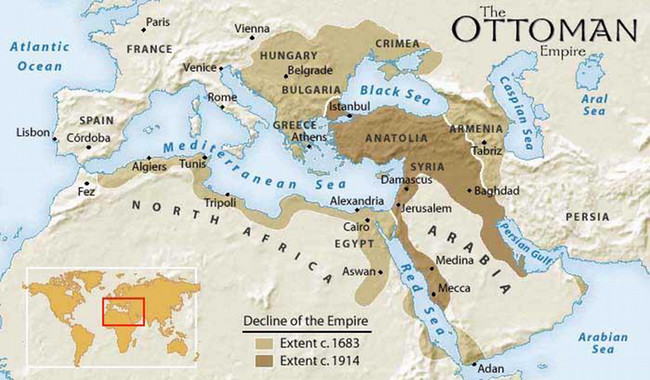
August 27 (W) What do we know, or think we know?

Class Preparations
be prepared to identify 1 thing that stands out in these maps
be prepared to respond to the following:
- What do you know about World War I in the Middle East?
- What challenges might you encounter as you study WWI in ME?
August 29 (F) Rethinking “The Long Great War”
Class Preparations
Jonathan Wyrtzen, Worldmaking in the Long Great War: How Local and Colonial Struggles Shaped the Modern Middle East (Columbia University Press, 2022), 1-28.
Rogan, The Fall of the Ottomans, preface
Akin, When the War Came Home, introduction
Reflections: When did WWI really start, and really end? What do these different historians tell us about the periodization of WWI in the ME? Why does Wyrtzen use the term “The Long Great War”? What fundamental idea does he recalibrate with the term’s use? How does Wyrtzen’s introduction compare with that of Akin or Rogan? What narrative strategy is used by each author (a hook for readers)? How do they hint at their approach & findings?
Mental Maps (Week 2)
September 1 (M) Western Reimagining(s) of the Mediterranean
Class Preparations
Elisabeth A. Fraser, “Skin of Nation, Body of Empire” in Mediterranean Encounters: Artists between Europe and the Ottoman Empire, 1774-1839 (Pennsylvania University Press, 2017), 165-206.
Reflections: What is the purpose of Elisabeth A. Fraser’s discussion of Louis Dupré’s travel book? How does this chapter help to explain the idea of the mental map? That “geography is not neutral” (p. 168)? What are the assumptions of many modern-day people (historians or otherwise) when discussing Greece? How does Fraser contribute to understanding the idea of a “mental map” that transcends physical geography (longitude & latitude)?
September 3 (W) The So-Called “Eastern Question”
Class Preparations
Huseyin Yilmaz, “The Eastern Question and the Ottoman Empire,” in Is There a Middle East?: The Evolution of the Geopolitical Concept, ed. Bonine et. al. (Stanford University Press, 2012), 11-35.
Reflections: What is the so-called Eastern Question in the 19th century? Why did this concept emerge in the 19th century? How does Yilmaz contribute to understanding the idea of a “mental map” that transcends physical geography (longitude & latitude)?
September 5 (F) Modernization in the “Sublime Porte”
Class Preparations
I will lecture today; no reading necessary, but:
upload your Unit Evaluation #1 before class
Lead Up to War (Week 3 & 4)
September 8 (M) The First and Second Moroccan Crisis
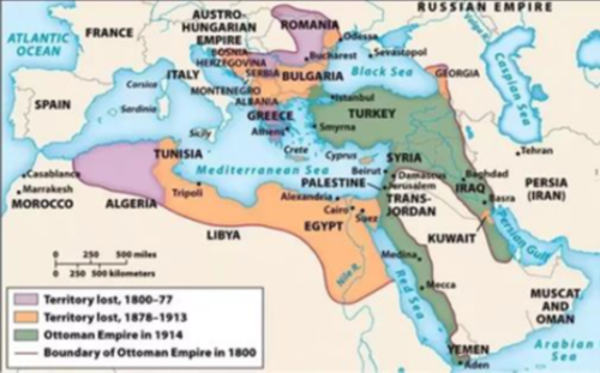
Class Preparations
Susan G. Miller, “The Passing of the Old Makhzan (1894-1912),” in A History of Modern Morocco (Cambridge University Press, 2013), 56-87.
Reflections: What is the meaning of the term makhzen? What are the First and Second Moroccan Crises? Bases on the map and the reading of this chapter, be prepared to list three reasons that European states sought to conquer the kingdom of Morocco?
September 10 (W) Zionist Immigration to Ottoman Palestine
Class Preparations
James L. Gelvin, “Cultures of Nationalism,” in The Israel-Palestine Conflict: A History, 4th ed. (Cambridge University Press, 2021), 15-46.
Reflections: How does Gelvin’s chapter link events and conditions in Europe to the emergence of a vaguely defined Islamic East (what will eventually emerge as the Middle East)? How did the Ottoman empire differ from the empires England and France were establishing in places like Morocco (an independent kingdom that was *not* part of the Ottoman Empire? What does Gelvin mean when he writes, “nationalism create nations” (19).
September 12 (F) The Seeds of Conflict
Class Preparations
watch film, Ben Loeterman, “Seeds of Conflict,” 2015 (53 min.)
Reflections: The narrator of the film talks over images of 2015 at the start (min. 3). He asks, “how did this place become the site of a bitter and seemingly intractable struggle?” Did the documentary adequately answer this question? How so? How not so?
*I will provide a worksheet w/ more questions on Brightspace*
September 15 (M) The Era of the Young Turks
Class Preparations
Akin, When the War Came Home, ch. 1 (15-51)
Rogan, The Fall of the Ottomans, ch 1 (1-28)
Reflections: Who are the Young Turks, and what were their intentions in deposing Abdulhamid II? How did the reality of their rule contrast with their stated intentions and popular expectations? Why didn’t Ottoman Patriotism take hold?
September 17 (W) The Ottoman Declaration of War
Class Preparations
Rogan, The Fall of the Ottomans, preface & ch. 2, 3.
Reflection: How many reasons can you identify to explain the Ottoman decision to enter WWI (list, w/ page #s)? What do you feel is the most compelling reason? Why? Is it the author’s presentation that makes this reason compelling? Or something else? What reason would you emphasize as a historian? Why?
September 19 (F) No Class
Class Preparations
no class, but you must upload your Unit Evaluation #2
Opening Salvo (Week 5 & 6)
September 22 (M) Ottoman Mobilization
 |
 |
Class Preparations
Akin, When the War Came Home, ch 2 (52-81)
Akin, When the War Came Home, ch. 3 (83-110)
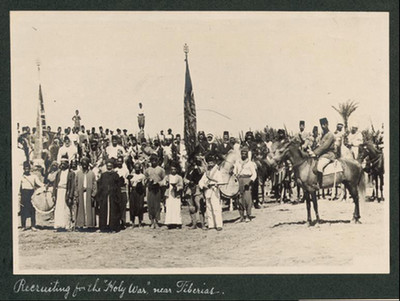
Reflection: How does a state—an empire w/ territory on 3 continents—convince its people to fight (and die) in a war against European powers? How does Akin balance discussion of the role of the imagination (crafting a ‘war story’) with the nuts-and-bolts needs of wartime institutions and infrastructure in Ottoman lands? How does Akin show these elements being manipulated by Ottomans? How do the archived photos contribute to your understanding of the Ottoman’s mobilization?
September 24(W) “A Time of Radical & Far-Reaching Change”
In-Class Viewing, Aljazeera, “The Ottomans,” Episode 2, 45 min.
Class Preparations
As you watch the film in class, list “radical and far-reaching changes” presented...how does filmmaker catch your attention. As film ends, polish up your notes and sent them to me via email.
September 26 (F) Opening Moves: Where, and Why?
Class Preparations
Rogan, The Fall of the Ottomans, ch. 4, 5, 6.
Reflection: In reviewing Rogan’s book, Kevin Jones wrote, “Somewhat contrary to popular perception, the Ottoman Empire did not suffer total defeat in the war, and the Middle Eastern theater of war was not a marginal sideshow to the conflict in Europe” (H-Empire, September 2017). How do the information & events described in these chapters support Jones’s statement?
September 29 (M) Early Ottoman Victories
Class Preparations
Rogan, The Fall of the Ottomans, ch. 8, 9 & 10.
Reflections: According to Rogan, “the war planners [in England] feared the reverberations across the Muslim world of two such great Ottoman victories over the British.” Where did Ottoman armies repel British forces? What accounts for their success? With what effects on the overarching waging of the war?
October 1 (W) Colonized North Africans in Europe
In-class film viewing, Aljazeera, “World War I through Arab Eyes,” 44 min, Episode 1, see here, https://www.aljazeera.com/program/featured-documentaries/2014/12/3/world-war-one-through-arab-eyes
Class Preparations
reread Rogan, The Fall of the Ottomans, 60-65
Reflections: The filmmaker shows that-1. Colonial subjects from France’s North African colonies played a key role in the Western Front; and 2. Racist attitudes prevailed among French troops, who may have used colonized Arabs as cannon fodder. What narrative choices are made by the filmmaker to convince you of the importance of these claims? Do you any perceive cracks?
As the film ends, polish up your notes and turn them into me.
October 3 (F) Islampolitik & British Anxieties
Class Preparations
Cemil Aydin, The Idea of a Muslim World: A Global Intellectual History (Harvard University Press, 2017), 1-13 (Intro).
The Political & Secret Department of the India Office, “The War: German Attempts to Fan Islamic Feeling,” 26 November 1915, The British Library, IOR/L/PS/11/99.
Reflections: What is Aydin’s core thesis? Review Rogan’s discussion of European anxieties about the loyalties of Muslim subjects (47-50, 54, 67-74) considering Aydin’s discussion of “the idea of a Muslim world.” Then analyze the British Library document and do so without neglecting its handwritten pages or marginalia. Print it out and write notes on it (questions, comments, discussion points)? What information does the document provide? How can you excavate this document for information?
Library Literacy Project (Weeks 7 & 8)
October 6 (M) What does neutrality really mean?
--Library Literacy Project
Class Preparations
Woodrow Wilson, “An appeal by the President of the United States to the citizens of the Republic, requesting their assistance in maintaining a state of neutrality during the present European war,” 19 August 1914, “https://history.state.gov/historicaldocuments/frus1914Supp/d886
“Called to Bagdad to Kill Mosquitos: Jersey Exterminators Sail for the Euphrates,” New York Times, 29 August 1915, p. 13.
Reflections: How does Woodrow Wilson define “neutrality”? Is his definition based on legal, moral, economic, political ideas? How so? What is neutrality’s purpose? What activities were allowed (or not) by the neutral US? Were American exterminators working in Baghdad respecting US neutrality? Why or why not?
October 8 (W) Using Purdue Databases
--Library Literacy Project
Class Preparations
*bring your computer to class
unit evaluation #3 due before class
October 10 (F) Using Online Archives
--Library Literacy Project
Class Preparations
*bring your computer to class
October 13 (M) Fall Break, No Class
October 15 (W) Presentations on Neutrality Findings
Class Preparations
*print out one document, put comments and questions on it, and be prepared to present it to the class if you are selected
October 17 (F) Presentations on Neutrality Findings
Class Preparations
*print out one document, put comments and questions on it, and be prepared to present it to the class if you are selected
Ottoman Victories (Week 9)
October 20 (M) British Occupation of Basra
Class Preparations
C.M. Cursetjee, “British Military Rule in Basra,” in The Land of the Date (1918; reprint, Westphalia Press, 2016), 163-176.
- Birch Reynardson, Mesopotamia, 1914-15: Extracts from a Regimental Officer's Diary (A. Melrose, 1919), 41-50.
Reflection: Compare the perspectives of Cursetjee and Reynardson. What insights do these accounts provide about daily life under British rule during World War I? What other questions would you like to answer? Examine ‘silences’ of these sources. What do think might have been discussed but was not...?
October 22 (W) Kut al Amara, British Defeat
Class Preparations
no readings for today, I will lecture on Mesopotamia campaign
***but, library literacy evaluation due before class
October 24 (F) Representing Victory
Class Preparations
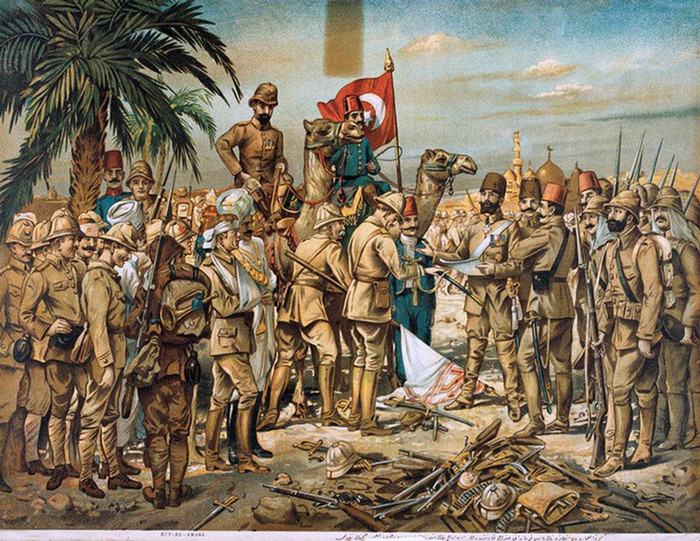
Anonymous Artist, “British Capitulation at Kut al-Amara,” Chromolithograph, 1918, National Army Museum, NAM. 1960-09-35-2.
review OWL on using visual sources, https://owl.purdue.edu/owl/general_writing/visual_rhetoric/analyzing_visual_documents/index.html
Reflections: How would you compare the image of Ottoman victory above with its reality on the ground? Or, as important, this work of propaganda with that of John Buchan’s Greenmantle? Assess the image pasted above, which is part of the online collection of the UK’s National Army Museum. What is it? What purpose does it serve? What can you tell me about the author? What do you see in the image? And how does this source complement or compete with information presented by Rogan?
The Lives of Civilians (Weeks 10 & 11)
October 27 (M) The Armenian Genocide, part 1
Class Preparations
Rogan, “The Annihilation of the Armenians,” 159-184 (ch. 7)
Karnig Panian, Goodbye Antoura: A Memoir of the Armenian Genocide (Stanford University Press, 2015).
Reflection: Who is Karnig Panian, and how does his memoir complement Rogan's Chapter 7? What perspectives does Panian provide that Rogan did not? What information was new to you? Is this source reliable? What can it tell you? What can’t it?
October 29 (W) The Armenian Genocide, part 2
October 31 (F) No Class, Work on Your Review
November 3 (M) Famine in the Levant
Class Preparations
Akin, When the War Came Home, ch. 4 111-143.
Falih Rifki, “Yet Another Soirée,” in The Ottoman Twilight in the Arab Lands: Turkish Memoirs and Testimonies of the Great War, ed. Selim Deringil (Academic Studies Press, 2019), 43-44.
Ihsan al Turjman, “My Job with Commander Ruşen Bey at the Commissariat,” 29 March 1915, in Year of the Locust: A Soldier’s
Diary and the Erasure of Palestine’s Ottoman Past, Salim Tamari, ed. (University of California Press, 2011), p. 92-94.
Reflections: Amartya Sen’s Poverty and Famines: An Essay on Entitlement and Deprivation (1981) opens with the following statement: “Starvation is the characteristic of some people not having enough food to eat. It is not the characteristic of there being not enough food to eat. While the latter can be the cause of the former, it is but one of many possible causes” (p.1). One reviewer said of Amartya Sen's central argument: “In the 20th century, famine--the precipitate decline of food consumption to a level that condemns many people to hunger, sickness, and death--like chronic starvation, is no longer an act of nature.”
So...how does Akin account for the famine in the Levant?
November 5 (W) Everyday Life in Wartime Jerusalem
Ihsan Turjman, Year of the Locust: A Soldier’s Diary and the Erasure of Palestine’s Ottoman Past, ed. Salim Tamari (University of California Press, 2015), 91-160.
*print out a diary entry and turn it in with marginal notes*
Reflection: Ihsan Turjman is a soldier in the Ottoman Army born and raised in Jerusalem, where he serves during the war. What can you glean from his diary? What do his entries tell you about political belonging in Ottoman Jerusalem? The experiences of women? Intra-sectarian or intra-ethnic relations? Zionism? Class and status? Or crises caused by mobilization in this city? What perspective does the diary provide that seem uniquely able to help you understand the reality of wartime conditions?
November 7 (F) Women in Wartime Mesopotamia
Class Preparations
Akin, “In the Home” Wives and Mothers,” 144-162 (ch. 5)
Violette Shamash, Memories of Eden: A Journey through Jewish Baghdad (Forum Books, 2008), in Holden, ed., A Documentary History of Modern Iraq (University Press of Florida, 2011), 47-50. [acct. of WWI by Jewish woman from Baghdad who was child]
Kermit Roosevelt, War in the Garden of Eden (Scribner’s, 1919), selection.
Reflections: How do these sources—memories of a very old woman (Jewish) who remembers Baghdad as a child, and the memoir of an American who fought with British troops—help to show something of women’s lives in Baghdad during WWI? Compare these accounts What sorts of stories do they tell about women in war? And how?
Changing Momentum (Weeks 12 & 13)
November 10 (M) Husayn-McMahon Correspondence
Class Preparations
Rogan, The Fall of the Ottomans, ch. 11
Document 16, “1915-1916 Husayn-McMahon Correspondence, in Bunton and Wender, The End of the Ottoman Empire, 163-166.
Reflections: Why did the British support an Arab Revolt led by the Amir of Mecca? Why him, and not another? Why did the Amir of Mecca throw his lot in w/ the British, not the ruling Ottomans?
November 12 (W) The Arab Revolt
Class Preparations
review Turjman entries dealing with Arabs, Arabic, etc.
TE Lawrence (i.e. of Arabia), “Akaba, Suez, Allenby,” in Revolt in the Desert [abridged] (1927, reprint; Tauris, 2011), 124-129.
Ahmed Djemal, “The Arab Rebellion,” in Memories of a Turkish Statesman, 1913-1919 (Hutchinson, 1919), 195-237.
Reflections: Consider the different viewpoints of each author—who are they? What sort of social or political world do they represent? And how do these differences show themselves in their first-hand accounts of the Arab Revolt? As a historian, how would you make sense of these two different accounts?
November 14 (F) No Class
Class Preparations
no class, but your primary source evaluations due today
November 17 (M) Losing Ground
Rogan, The Fall of the Ottomans, ch. 12 and 13
Reflections: Why was 1917 a turning point in Eastern Theatre?
November 19 (W) The Balfour Declaration
Class Preparations
Arthur Balfour, “The Balfour Declaration,” 2 November 1917.
Reflections: Why did the British government issue the Balfour Declaration in November 1917? Why not in March 1916? Or February 1918? Etc. Why was it issued at this specific moment?
November 21 (F) Ending and Outcomes, part II
Class Preparations
watch Part 3 of “World War I in Arab Eyes,” Aljazeera (2014), each about 45 min. https://www.aljazeera.com/program/featured-documentaries/2014/12/3/world-war-one-through-arab-eyes
Reflections: What is World War I’s legacy in the Middle East? How did it affect the social, political, and economic life of this region? And how might it still be playing out today?
November 24 (M) Thanksgiving
November 26 (W) Thanksgiving
November 28 (F) Thanksgiving
Post-War Counterfactuals (Weeks 15 & 16)
December 1 (M) The King Crane Commission in Palestine
Class Preparations
Andrew Patrick, “’These people know about us’: A Reconsideration of Greater Syrian Attitudes Towards the United States in the First World War Era, Middle Eastern Studies, 50, no. 3, 397-411.
“The American King-Crane-Commission Report, 1919," in Akram Fouad Khater, Sources in the History of the Modern Middle East (Houghton Mifflin, 2004), 203-209.
“The Zionist Organization’s Memorandum to the Peace Conference in Versailles, February 3, 1919,” 193-200.
“The Resolution of the General Syrian Congress at Damascus, July 2, 1919,” 200-202.
Reflections: What are the competing claims of the Zionist Organization and General Syrian Congress, and how did the claims affect the King-Crane Commission report? How might the historical trajectory of Palestine and the world have changed if the King-Crane Report recommendations had been implemented?
December 3 (W) British Colonization of Iraq
Class Preparations
Charles Tripp, A History of Iraq, 3rd ed. (Cambridge University Press, 2010), 30-51.
Wallace Lyon on “The Kurdish ‘Election’ of King Faysal,” in Stacy E. Holden, A Documentary History of Modern Iraq (University Press of Florida, 2012), 74-78.
Mahdi al-Khalisi on “Shia Opposition to (Rigged) Elections,” in Stacy E. Holden, A Documentary History of Modern Iraq (University Press of Florida, 2012), 81-86.
Reflections: What were the needs (objectives) of England after World War I? What were its policy interests as they hammered out the peace? Was there a way to secure these interests without the colonization of Iraq and other places in the “Middle East”?
December 5 (F) Turkish Greek Population Exchange
Class Preparations
Sarah Shields, “The Greek-Turkish Population Exchange,” Middle East Report 267 (Summer 2013).
Mustafa Kemal, “His Vision of the Recent Nationalist Past of Turkey and the Future of the Country, 1927,” in Akram Fouad Khater, Sources in the History of the Modern Middle East (Houghton Mifflin Company, 2004), 145-152.
Reflections: What was the logic behind the international support for what was in fact if not intent ethnic cleansing? What does it reveal about preconceived political notions of that time?
December 8 (M) No Class
December 10 (W) No Class
December 12 (F) No Class
December 15 (M) Unit Evaluation #4 Due on Brightspace
University Policies:
Plagiarism Will Not Be Tolerated at Purdue University: Plagiarism is a crime, and students can be expelled for turning in a paper that they did not write. Copying a person’s work verbatim is not the only form of plagiarism. In some cases, plagiarism involves paraphrasing the idea of another without a footnote or the repetition of another author’s phrase. Students are advised to consult Purdue University’s Guide to Academic Integrity for guidelines at: http://www.purdue.edu/ODOS/osrr/integrity.htm. Plagiarized work will receive a 0, and the professor reserves the right to forward the case to the administration for further review by a dean.
Here Is the Purdue University Policy for Academic Dishonesty: Purdue prohibits "dishonesty in connection with any University activity. Cheating, plagiarism, or knowingly furnishing false information to the University are examples of dishonesty." [Part 5, Section III-B-2-a, Student Regulations] Furthermore, the University Senate has stipulated that "the commitment of acts of cheating, lying, and deceit in any of their diverse forms (such as the use of substitutes for taking examinations, the use of illegal cribs, plagiarism, and copying during examinations) is dishonest and must not be tolerated. Moreover, knowingly to aid and abet, directly or indirectly, other parties in committing dishonest acts is in itself dishonest." [University Senate Document 72-18, December 15, 1972] https://www.purdue.edu/odos/academic-integrity/
Purdue University Policy Prohibits Discrimination: Purdue University is committed to maintaining a community which recognizes and values the inherent worth and dignity of every person; fosters tolerance, sensitivity, understanding, and mutual respect among its members; and encourages each individual to strive to reach his or her own potential. In pursuit of its goal of academic excellence, the University seeks to develop and nurture diversity. The University believes that diversity among its many members strengthens the institution, stimulates creativity, promotes the exchange of ideas, and enriches campus life. Purdue University prohibits discrimination against any member of the University community on the basis of race, religion, color, sex, age, national origin or ancestry, genetic information, marital status, parental status, sexual orientation, gender identity and expression, disability, or status as a veteran. The University will conduct its programs, services and activities consistent with applicable federal, state and local laws, regulations and orders and in conformance with the procedures and limitations as set forth in Executive Memorandum No. D-1, which provides specific contractual rights and remedies. Any student who believes they have been discriminated against may visit www.purdue.edu/report-hate to submit a complaint to the Office of Institutional Equity. Information may be reported anonymously. http://www.purdue.edu/purdue/ea_eou_statement.html
Accessibility and Accommodation: Purdue University strives to make learning experiences as accessible as possible. If you anticipate or experience physical or academic barriers based on disability, you are welcome to let me know so that we can discuss options. You are also encouraged to contact the Disability Resource Center at: drc@purdue.edu or by phone: 765-494-1247.
Disclaimer: In case of a major campus emergency, the requirements on this syllabus are subject to changes required by a revised semester calendar. Any changes will be posted, once the course resumes, on the course website. It may also be obtained by contacting the instructor via email