Shaping the Future of Space Diplomacy Through Degree Plus
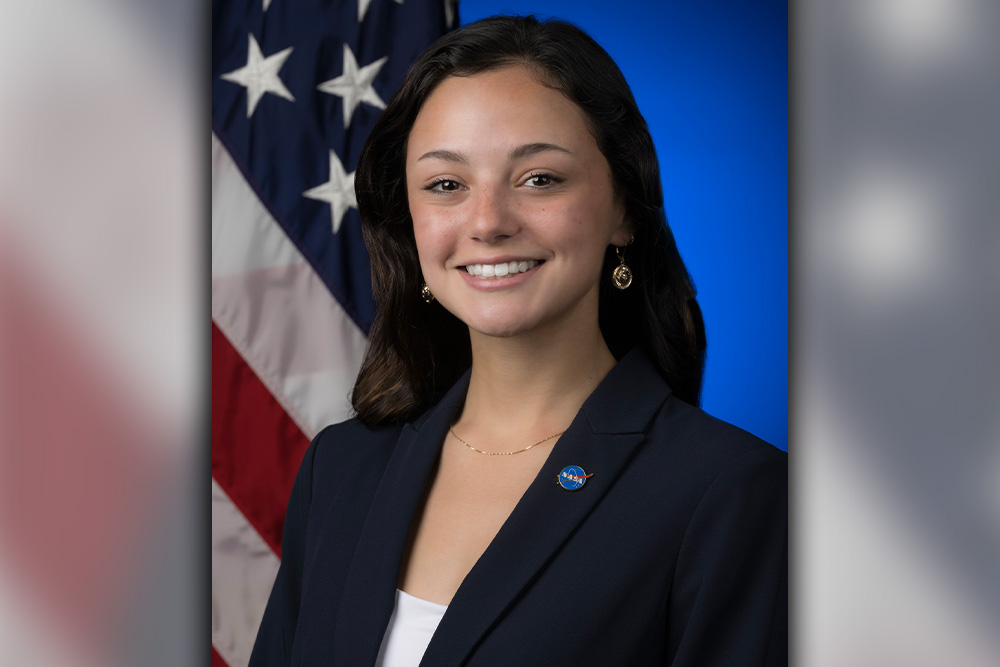
Designing the next generation of spacecraft requires more than technical expertise. It also demands a deep understanding of the policies and partnerships that shape mission funding and space governance.
Purdue junior Lucia Morton recognized that reality before she ever stepped into a college classroom. After high school, she spent a year interning at the NASA Langley Research Center. As a high temperature materials and structures intern, she helped study advanced materials that can withstand extreme flight conditions.
“Throughout my experience at Langley, I was exposed to the ways changing administrations can impact research and how leadership can trickle down into activities in the lab,” Morton recalls. “I got super curious about science policy — how funding mechanisms work and what motivates certain investments and lines of research.”
Through the Degree Plus program in Purdue’s College of Liberal Arts (CLA), Morton is pursuing a dual degree in aerospace engineering and political science. This combination allows her to look at space exploration not just through the lens of fluid dynamics, but also through the shifting geopolitical landscapes that dictate where and why we travel.
“Incorporating CLA curriculum into my education was non-negotiable for me,” Morton says. “In my opinion, all engineers should understand the political and historical context of the missions and initiatives they contribute to.”
When she came to Purdue, two things stood out: the world-class propulsion facilities at Zucrow Laboratories and the unique humility of faculty and researchers. What solidified her choice was discovering that through Degree Plus she could blend her passion for public policy with top-tier engineering coursework.
“My dual degree equips me with exactly what I need to effectively help shape the future of the space industry,” Morton said.
Morton has assembled an extensive list of experiential learning highlights across both STEM and humanities. From the Lawrence Livermore National Laboratory to defense research facilities and Washington, D.C. think tanks, her diverse experiences landed her the Job-Ready Summer Internship Award. Currently, she is completing a co-op at MIT Lincoln Laboratory, where she focuses on computational fluid dynamics (CFD).
“Lincoln provided a great opportunity to remain in a federal lab environment while also connecting with academia,” she says. “The quality of mentoring and breadth of project experience you receive at a national lab is unparalleled.”
Morton served as an intern with the Krach Institute for Tech Diplomacy following her experience in the Boilers Go to D.C. program, allowing her to bridge high-tech innovation with foreign policy and examine issues like AI safety and maritime security.
Morton’s College of Liberal Arts education has given her the practical communication skills she needs to combine disciplines and enhance the technical skills she’s gained. While engineering reports require technical detail, policy reports should be succinct and accessible.
“I've learned a lot about writing for executive consumption,” Morton says. “As engineers, we tend to overexplain ourselves to meet the demands of our work. Liberal arts teaches you to get to the point and give decision-makers the exact answers they care about.”
The CLA classroom environment itself has offered Morton a shift in rhythm. In courses like POL 300 (Introduction to Political Analysis) with Professor Eric Waltenburg, she found room for deep, critical analysis.
“In engineering courses, there are a lot of technical details coming at us very quickly,” she explains. “What CLA grants you is the space for more free-form, interactive discussion where you can reflect and share opinions with your peers.”
Morton describes a liberal arts perspective as a professional necessity for the next generation of aerospace leaders. She serves as an ambassador for the Innovation in Public Service Certificate program, encouraging other STEM students to pursue opportunities beyond the lab.
“I think it's our responsibility to take advantage of the unique academic environment that many of us may not have access to beyond undergrad,” she says. “As a math and science-oriented student, CLA facilitates opportunities for me to communicate efficiently and think more critically.”