Beyond Perfection: Student Designer Finds Meaning in the Abstract
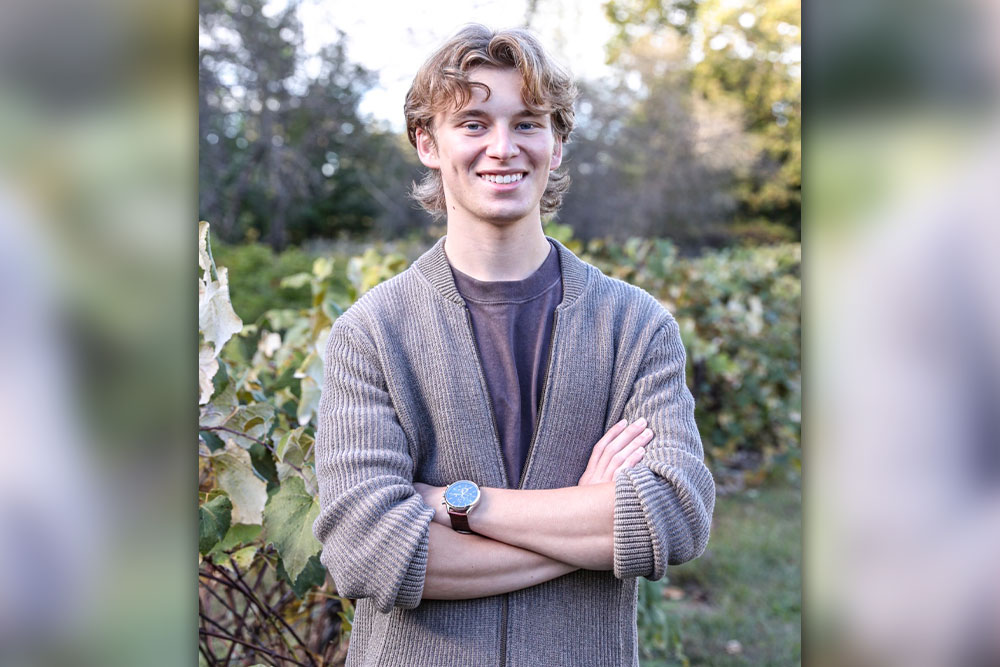
Grayden Artusi arrived at Purdue with a plan to become a veterinarian. After a year of chemistry and biology courses, he discovered his interests were leading him in a different direction. He consulted his advisor and made a decision that would redefine his life. Artusi changed his major to visual communication design in Purdue’s College of Liberal Arts (CLA).
Artusi began his sophomore year immersed in design fundamentals like color, composition, shape and balance. Instead of memorizing chemical equations, he learned how to speak without words. Visual communication design, he explained, is about using graphic elements to communicate clearly and intentionally. Early courses taught him how two-dimensional design choices inform a viewer’s reaction.
Going far beyond technical training, his CLA courses began reshaping how he thought about art itself. Before taking modern art history, Artusi admits he used to look at abstract art and think, “This is meaningless. I don’t get it.” But in class, when professors unpacked the historical context and human emotion behind the work, he felt a shift. He realized that something that appears to “mean nothing” can be deeply emotional and profoundly human.
One of the biggest transformations Artusi experienced through his liberal arts education was letting go of perfection. He once believed that being an artist meant mastering realism. He strived to draw and sculpt people so precisely that they looked flawless, but his professors challenged that idea. They pushed him to ask different questions: What do I think? What do I feel? Instead of correcting “mistakes,” he learned to turn them into meaning.
That perspective expanded even further when he got the opportunity to take electives for his major. Ceramics became one of the most formative experiences of his college career. Working physically with clay, he created three-foot-tall body-centered sculptures that combined distorted human forms with everyday objects. The pieces felt strange and alien, but that was the point.
While artists can be tempted to tell viewers what to think, Artusi prefers ambiguity. His goal is to create work that acts as a mirror where the viewer’s reaction reveals something about themselves.
“There’s a self-sacrifice in letting people assign their own meaning,” Artusi said. But he believes personal interpretation is where beauty lies. He wants a dialogue where people are empowered to say what they think and why.
That mindset helped him earn first place in the undergraduate division at Purdue’s annual juried art show, an affirmation that his abstract, exploratory approach resonated with his audience.
Artusi credits much of his growth to the culture within liberal arts. Compared to large lecture courses, his art and design classes feel intimate. Smaller class sizes have helped him create stronger, more personal connections through two-way dialogue with professors and peers.
“It never lacks professionalism," he explained, “but it is fundamentally human.”
Even in conversations about AI, his perspective reflects a belief that human connection is the foundation of art. While he acknowledges AI’s practical uses, he said the community, the dialogue, and the emotion cannot be replicated by a generated image.
Artusi speaks passionately about the professors who shaped him. Particularly Sigrid Zahner, a ceramics professor whom he calls one of the most influential teachers he has ever had, who pushed him beyond corporate polish and into personal expression.
“She gave me the opportunity,” he said, “almost the permission, to throw myself into art where I could feel myself in it.”
That permission to explore, question, and show up imperfectly transformed his understanding of himself, giving him the confidence to create a future that feels authentically his.
As graduation approaches, Artusi feels both excitement and bittersweet nostalgia. He is assembling his graphic design portfolio and searching for new opportunities, hoping to work at a marketing or branding agency. He loved designing a food truck brand in one class and could see himself freelancing someday.
But for Artusi, success is no longer defined by a job title alone. His time in liberal arts reshaped how he measures fulfillment. Making a living matters, but passion is what sustains it.