Purdue Anthropologist's Grubby Research Captures Global Scientific Attention
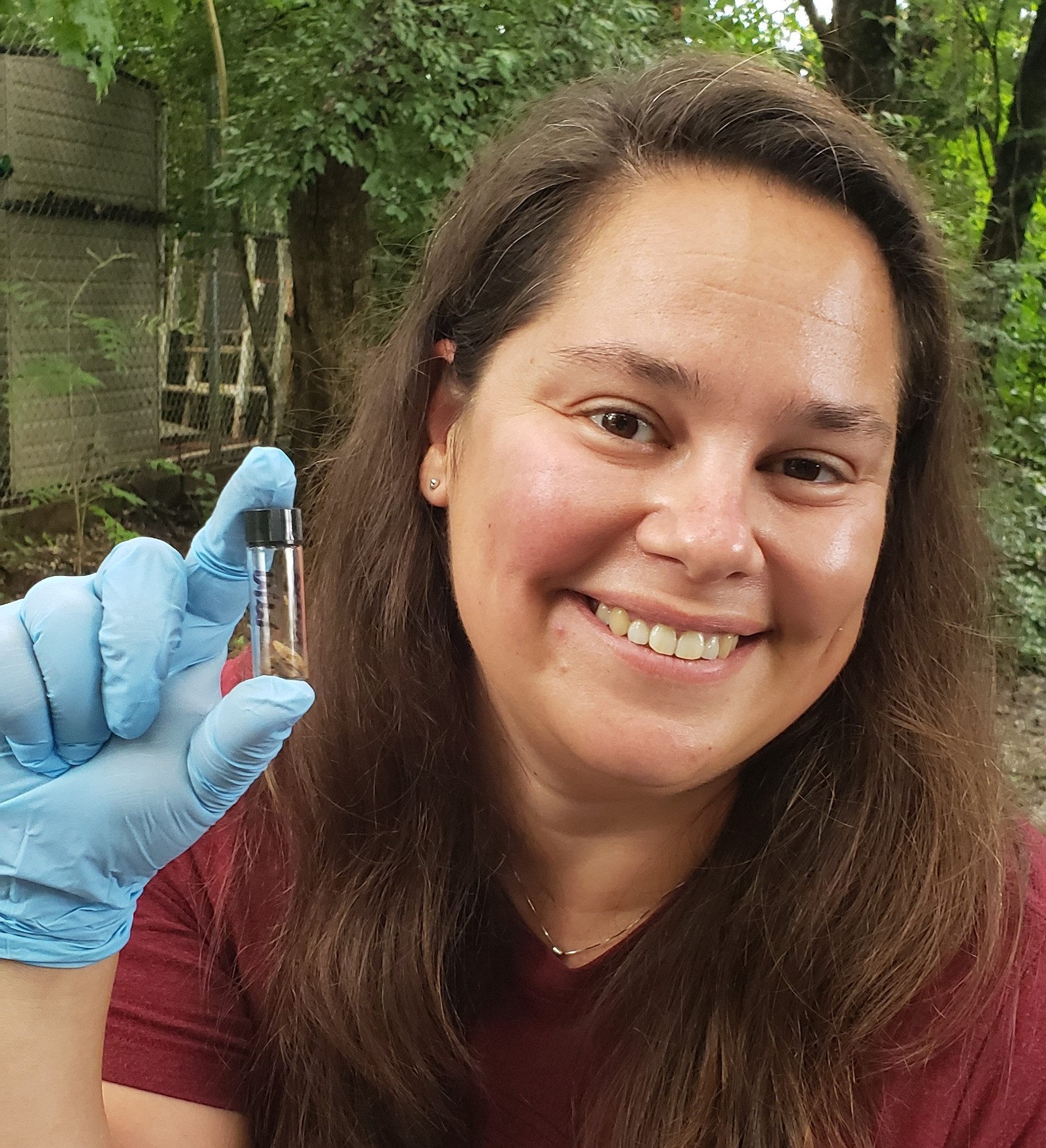
Assistant Professor of Anthropology Melanie M. Beasley’s recent research has become a squirming success across multiple prestigious scientific news outlets and capturing international media attention. Published in Science Advances, her innovative study on Neanderthal dietary habits that would make Timone and Pumba blush has garnered widespread coverage in major publications including Nature, Science News, HISTORY, and numerous other outlets, marking a significant career milestone for the anthropologist.
Beasley's research, titled “Neanderthals, hypercarnivores, and maggots: Insights from stable nitrogen isotopes,” addresses a long-standing puzzle in paleoanthropology regarding the extraordinarily high nitrogen-15 values found in Neanderthal remains. Her study proposes that consumption of putrefied meat laced with maggots could explain these isotopic signatures, challenging previous assumptions about Neanderthal dietary behavior. The research methodology was both innovative and rigorous, involving analysis of muscle tissue from 34 human cadavers over two years at the University of Tennessee's Forensic Anthropology Center, along with examination of hundreds of fly larvae samples.
"The project was an opportunity to use a single dataset to test two different questions,” Beasley shared with the College of Liberal Arts. “In forensic anthropology, could change in stable nitrogen isotope values of muscle tissue and maggots during decomposition be used as a method to estimate time since death? And in paleoanthropology, would nitrogen isotope values increase during decomposition enough to explain the high nitrogen results seen in Neanderthals and other Pleistocene hominins? I was honestly shocked at the extremely high nitrogen values of the maggots and the implications the results had for forensic casework and Neanderthal research."
As director of Purdue's Bioanth Isotope Ecology Research Laboratory (BIER Lab), Beasley has established herself as a leader in stable isotope geochemistry applications in anthropology. Her research focus spans paleoanthropology, bioarchaeology, and forensic anthropology, with particular expertise in stable isotope ecology and human-environment interactions.
Beyond the immediate impact of this particular study, Beasley's publishing success demonstrates her commitment to the Department of Anthropology's “Anthropologies of Tomorrow" approach: an interdisciplinary focus that blends social and natural sciences in ways that make anthropology relevant to contemporary challenges. Her emphasis on science communication, evident in the broad media coverage her work has received including an article Beasley herself wrote for the Conversation, aligns with growing expectations for academic researchers to engage with public audiences.
This research has also opened new avenues for future investigation, with colleagues noting the need for additional archaeological evidence to support the maggot consumption hypothesis. This suggests that Beasley's publication may be the foundation for an ongoing research program that could yield additional high-impact papers in the years ahead.
For Purdue University’s College of Liberal Arts, Beasley's achievement represents a significant contribution to the institution's research profile in anthropology and related fields. The global attention generated by her research enhances the university's reputation for innovative, interdisciplinary scholarship that addresses fundamental questions about human evolution and behavior.
This publishing milestone underscores the importance of creative thinking and methodological innovation in academic research, demonstrating how novel approaches to existing problems can generate findings significant enough to capture both scholarly and public attention around the world.