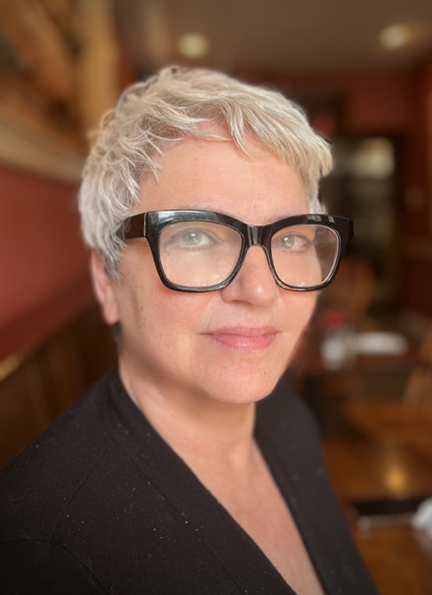
Tracey Jean Boisseau
- Professor Emerita // Women's Gender and Sexuality Studies // SIS
- Professor Emerita // SIS
- Professor Emerita (Courtesy) // History
Office and Contact
Email: tjboisseau@purdue.edu
Tracey Jean Boisseau is an interdisciplinary feminist studies scholar and cultural historian of U.S. women and transnational feminism. In 2012, after 13 years as a member of the Department of History at The University of Akron in Ohio, she came to Purdue University to lead the Women’s, Gender & Sexuality Studies Program (2012-17). In May of 2025, she became an emerita of the Purdue WGSS program and School of Interdisciplinary Studies with a courtesy appointment in History and affiliations with American Studies, the African American Studies and Research Center, the LGBTQ Center, and the Susan Bulkeley Butler Center for Leadership Excellence.
TJ received her PhD in U.S. women’s history from (SUNY) Binghamton University in New York, an MA in U.S. history from Georgetown University in Washington, D.C., and a BA in history and women’s studies from Suffolk University in Boston. She was born in the small town of Ayer, Massachusetts. She currently makes her home in another small community in mid-coast Maine where, since her liberation from the American academy, she operates the Feminist Flying University (FFU)—a freedom school inspired by the underground resistance to authoritarianism exhibited by many courageous European intellectuals over the long 20th century; by the emancipatory vision of anti-colonialist education outlined by the Brazilian activist Paolo Freire, in his Pedagogy of the Oppressed; by countless African-American women who secretly taught literacy within their communities even when it was outlawed by white slavers and the punishment severe; and by a very long and world-wide history of individual women’s pursuit of intellectual achievement in the face of systemic exclusions from formal education.
TJ’s four decades-long teaching career and belief that teaching can and should be world-changing began in 1985 as a teaching assistant at Georgetown University. Over the first 13 years in the profession, as a graduate student and young professional, her commitment to emancipatory pedagogy was honed by teaching at many levels and for many kinds of institutions—as a secondary-school history teacher at elite private schools such as Cranbrook-Kingswood Academy in Michigan and the Buckley School, the Los Angeles County High School for the Arts, and juvenile prisons including Compton Juvenile Hall and Julius Klein Conservation Camp in Los Angeles, California; at elite private colleges such as Clark University in Worcester, Mass and Loyola University in Chicago, Illinois; as instructor of ESL students at Suffolk University in Boston and non-traditional adult students at community colleges such as Elmhurst College in Illinois and Pierce Community College and Glendale Community College in southern California; as history professor at state universities including the University of lllinois at Chicago, SUNY-Binghamton in New York, Massachusetts College of Art in Boston, finally landing in 1999 at The University of Akron in Ohio where for 13 years she taught undergraduates, master’s, and doctoral students at UA’s Department of History and helped launch a new program in women’s and gender studies.
After 2012, and for much of her 13 years at Purdue University, TJ worked to build Purdue’s Women’s, Gender, & Sexuality Studies Program as well as the global field of feminist studies. Much of her time at Purdue was spent directly engaged in institutionalizing feminist studies and LGBTQ studies in student culture. She helped found Triota (the Purdue University chapter of the national WGSS honor society), as well as SARA-V (Students Against Rape and Violence), The Period Project, and the WGSS Graduate Student Organization. She was faculty advisor to F.A.C.T. (Feminist Action Coalition for Today), GRL (Gamma Rho Lamda), and the Gender Inclusive Learning and Residential Community. For three years, as the inaugural Amelia Earhart Faculty-in-Residence (2017-2020), she and her partner and daughter resided with 600 students in Windsor Hall, living in the apartment and following in the footsteps of Amelia Earhart who spent several inspiring weeks as faculty advisor to female students in Windsor in the mid-1930s.
Outside the United States, as the 2017 Fulbright Senior Scholar at the United Nations University Gender Equality Studies Training Programme at the University of Iceland, Dr. Boisseau mentored and taught transnational feminist theory, practice, and policy making to M.A. fellows from conflict-ridden societies including Palestine, Syria, Afghanistan, Somalia, Sudan, and Haiti. As a 2003-04 Fulbright Senior Scholar at the University of Bayreuth in Germany, she taught African American women’s history and feminist perspectives on American popular culture and film. In addition to archival research in Washington, D.C., New York, Massachusetts, Ohio, Illinois, Indiana, California, and Hawaii in the United States, she has performed original archival research and oral history in Cuba, Iceland, the United Kingdom, France, Belgium, Turkey, Lebanon, India, Morocco, and Tanzania.
Inside the U.S. and building off two articles she published on Anne Moody’s influential memoir, Coming of Age in Mississippi, Boisseau co-founded the Friends of Anne Moody, also serving as inaugural chair of FAM’s executive coordinating committee. Boisseau also founded and served as inaugural president of the Society for the Study of Women and Gender at World’s Fairs and Expositions. More recently, in a series of articles based on quantitative and qualitative ethnographic research of feminist studies practitioners, she has applied her research skills and historical perspective to produce meta-reflections on the current state of and politicized challenges experienced by the field of feminist studies in the United States and globally.
As a historian, the primary focus of Boisseau’s research has been women’s political and cultural interventions by way of a variety of nineteenth and twentieth-century popular mediums—including mass news media, travel literature, autobiography, popular film, and worlds’ fairs—for the contributions these interventions have made to the historical formation of American feminism as a set of national and transnational ideas, public practices, and identities.
Her earliest published books include a historical monograph, White Queen: May French-Sheldon and the Origins of American Feminist Identity (Indiana University Press, 2004) and a critical edition of May French-Sheldon’s 1892 travelogue, Sultan to Sultan: Travels among the Masai and Other Tribes of East Africa (orig. pub by Arena Press, republished by Manchester University Press, 1999). Both explore the degree to which racism, colonialism and ideas about Africa informed early formations of American feminist identity in the period 1890-1930.
Her co-edited volumes include Gendering the Fair (University of Illinois, 2009); Feminist Legal History (New York University Press, 2010); a special issue of the National Women’s Studies Association Journal (2008), “New Orleans: The Gender Politics of Place and Displacement”—the latter focused on women’s experiences during the 2005 hurricane, Katrina. More recently, she co-edited “Pandemonium”—a landmark issue of the Women’s Studies Quarterly (2024) that tracks the chaos the field of feminist studies has been thrown into stemming from an onslaught of politicized attacks on top of decades of neoliberal precarity and a global pandemic.
In addition to books, Boisseau’s body of published work includes over three dozen peer-reviewed book chapters, contributions to edited collections, articles and essays appearing in a wide range of history and interdisciplinary gender studies journals including:
Meridians: Feminism, Race, Transnationalism
Signs: Journal of Women and Culture in Society
Feminist Studies
Feminist Teacher
Gender & History
Women’s History Review
thirdspace: a journal of feminist theory and culture
Anthropology and Education Quarterly
Psychology of Women and Equalities Review (POWER)
The Akron Law Review
The Chicago-Kent School of Law Review
Boisseau’s autobiographical essays, creative writing, and poems have seen publication on the web and in international art and scholarly journals such as:
Ós—the Journal (Reykjavik, Iceland)
The AutoEthnographer (Istanbul, Turkey)
Mïtra: Revue d’Art de Littérature (Montreal, Canada)
European Journal of Women’s Studies (Utrecht, Netherlands).
In just her last year at Purdue, Boisseau’s twinned research foci on ethnographic research on the field of feminist studies and historical research on women at world’s fairs, saw peer-reviewed publication in:
Women’s Studies Quarterly
Feminist Studies
Journal of Women’s History
BIE Bulletin (the main organ for the Bureau International des Expositions
Frontiers: A Journal of Women’s Studies
Professor Boisseau’s newest book on world’s fairs entitled, Fair Amazons: Women, Rights, and Reform at the 1853 New York World’s Fair and Crystal Palace, is soon to be published by Oxford University Press.
TJ Boisseau and The Flying Feminist University can be reached at tjboisseau@purdue.edu.