David Atkinson
- Associate Professor // History
- Director of History Honors Program // History
- Affiliated Faculty // Asian American Studies // SIS
- Affiliated Faculty // American Studies // SIS
Research Focus
American Foreign Relations, Global Migration History, International History, American and British Imperial History
Office and Contact
Room: BRNG 6180
Office hours:
- Fall 2026:
- Tuesday, 12:30pm-1:30pm
- Wednesday, 10:30am-11:30am
Email: atkinsod@purdue.edu
Phone: (765) 496-2776
Fax: 765-496-1755
Courses
Hist 305 The United States in the World
Hist 371 Society, Culture, and Rock and Roll
Hist 395 Writing Global American Histories
Hist 421 Honors Historical Methods
Hist 422 Honors Thesis in Historical Research
Hist 371 Society, Culture, and Rock and Roll
Hist 395 Writing Global American Histories
Hist 421 Honors Historical Methods
Hist 422 Honors Thesis in Historical Research
Ph.D. Boston University
Specialization
American foreign relations and migration; international history; American and British imperial history
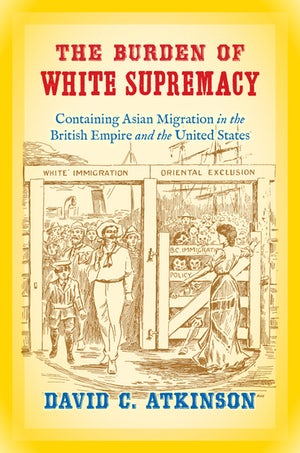
Originally from Leeds in the UK, I received my Ph.D. in history from Boston University in 2010. My most recent book is entitled The Burden of White Supremacy: Containing Asian Labor Migration in the British Empire and the United States. From 1896 to 1924, motivated by fears of an irresistible wave of Asian migration and the possibility that whites might be ousted from their position of global domination, British colonists and white Americans instituted stringent legislative controls on Chinese, Japanese, and South Asian immigration. Historians of these efforts typically stress similarity and collaboration between these movements, but I instead highlight the differences in these campaigns and argue that the main factor unifying these otherwise distinctive drives was the constant tensions they caused. Drawing on documentary evidence from the United States, Great Britain, Australia, Canada, South Africa, and New Zealand, I trace how these exclusionary regimes drew inspiration from similar racial, economic, and strategic anxieties, but nevertheless developed idiosyncratically in the first decades of the twentieth century. Arguing that the so-called white man’s burden was often white supremacy itself, I demonstrate how the tenets of absolute exclusion--meant to foster white racial, political, and economic supremacy--only inflamed dangerous tensions that threatened to undermine the British Empire, American foreign relations, and the new framework of international cooperation that followed the First World War.
I am working on a new book project that explores how Americans interacted with imports from around the world in the long 19th century as a way to understand the influence of the World in America. American prosperity during this period depended on imports from Europe, Asia, Africa, and Latin America. My book project analyzes the influence of these countless commercial, mineral, and agricultural imports on American politics, economy, and culture. Throughout this period, things from around the world nourished American bodies, empowered American industry, and enhanced American agriculture. At the same time, imports provoked debates about imperialism, race, regulation, tariffs, war, defense, and commerce that shaped the country’s political economy, helped craft the contours of its burgeoning state, and influenced every facet of life, from the kind of food people ate to the nation’s capacity to wage war and defend itself. As a complement and counterpart to this book, I am also working on a digital history project that maps imports and exports to the United States from 1790-1965. I am also the author of a book entitled In Theory and in Practice: Harvard's Center for International Affairs, 1958-1983, and in addition to these book projects I have also published articles on Asian migration in the Pacific Northwest, on the international resonances of American immigration restriction in the 1920s, and on the imperial and international implications of Australian immigration policy.
I am also working on a textbook on “The Modern United States and the World,” which is under contract with Routledge Press. This textbook will explore the multiple registers of American engagement with the world. It will help students see the myriad and often interrelated ways that Americans have related to the rest of the globe, both at home and abroad: from the formal state actions of the U.S. government and its interlocutors to the informal activities of ordinary Americans and citizens of other countries. In addition to exploring traditional expressions of American foreign relations—often manifested in diplomatic and military contexts—it will also foreground the flow of people, things, and ideas from the United States to the world and vice versa. Coca-Cola, rock and roll music, and Hollywood movies played an important role in “Americanizing” global cultures, just as Brazilian rubber, Jamaican reggae, and Peruvian guano played essential roles in the development of American industry, culture, and agriculture. By placing the activities of state and non-state actors from the United States and abroad in the same frame, it will enable students to understand the scale and complexity of Americans’ encounters with the world.
Dr. Atkinson is willing to supervise graduate students in U.S. foreign relations history and the history of the U.S. in the World.